

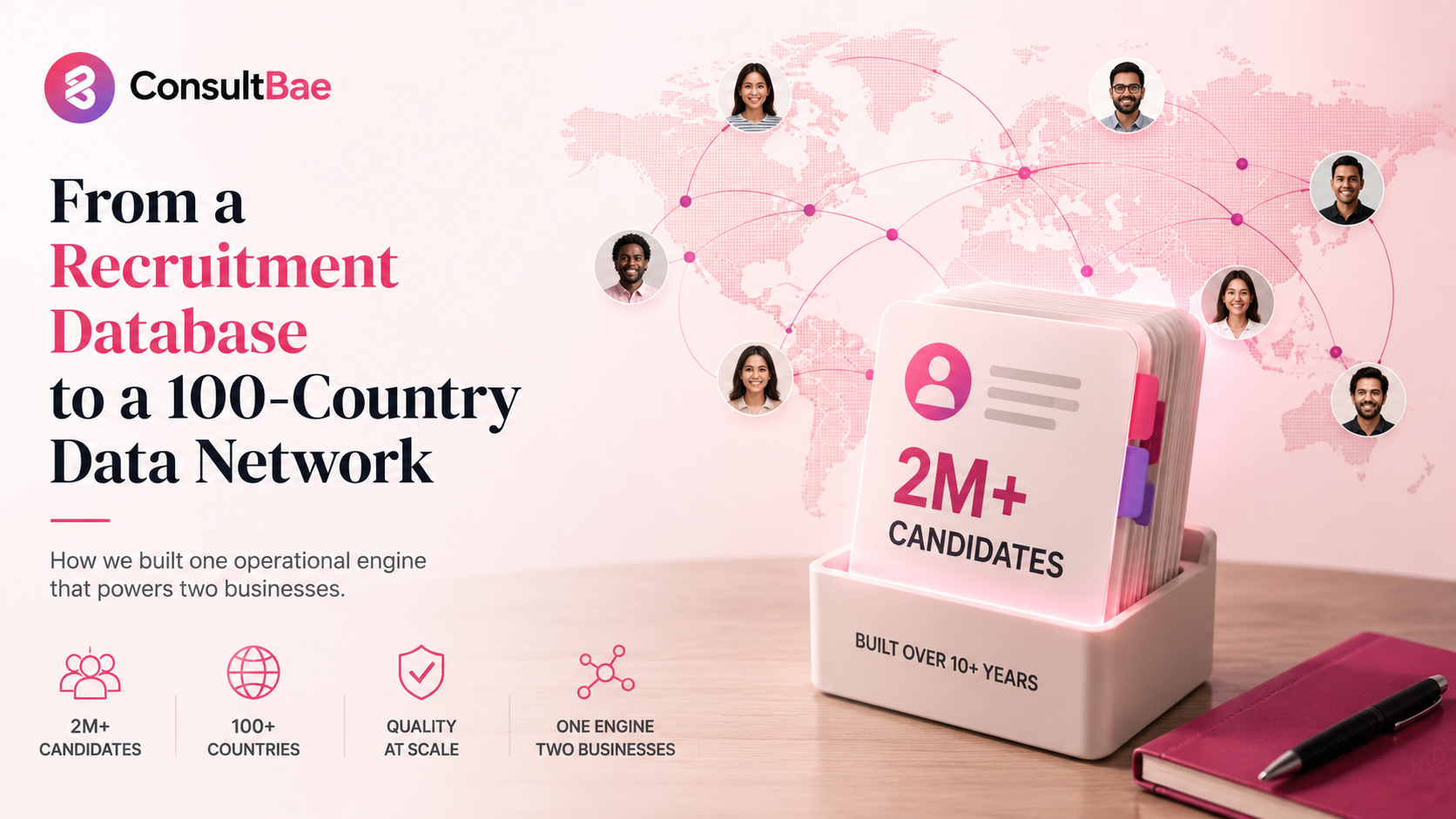
When people hear that ConsultBae runs AI data collection across 100-plus countries, the assumption is usually that this is a separate business we built deliberately, that we looked at the AI data market, saw an opportunity, and went and built the infrastructure to serve it.
That is not what happened. The infrastructure already existed. We had spent six years building it for something else entirely. All it took was one phone call asking us to use it differently.
What a recruitment database actually is
Most people think of a candidate database as a list of resumes. That is the surface of it. What you actually build over six years of active recruitment operations is something much more useful: a sourcing engine.
At ConsultBae, the database had grown to two million candidates by the time the AI data opportunity arrived. But the database itself was only part of the asset. What made it operationally powerful was everything built around it: a dedicated sourcing team trained to find specific profiles across paid and unpaid channels, a CRM and ATS system that we had been using since day one, automated outreach pipelines, and a first-level screening process that could qualify candidates quickly before they ever reached a client.
We had also split the recruitment function into three distinct teams: sourcing, first-level screening, and account management. Each team did only what it was best at. The result was that a single account manager could share fifteen-plus profiles in a day across eight to ten open roles simultaneously. Speed and quality were not in tension because the workflow had been engineered so they did not have to be.
That operational depth, built entirely for hiring, turned out to be almost exactly what AI data collection required. We just had not seen it that way yet.
The database was not the asset. The sourcing engine built around it was. And a sourcing engine does not care whether it is finding candidates or data contributors.
The moment the transfer became visible
The first AI data project was 100 people across six Indian languages. Press a button, read a prompt, record one hour of audio. When the client explained what he needed, the task itself was simple. What he could not find was a partner who could mobilise that many people, across that many languages, quickly and reliably.
We could. Because we had been doing something structurally identical for years. Finding people with specific profiles, reaching out at scale, qualifying them quickly, coordinating their participation in a process. The process had changed. The operational muscle behind it had not.
We delivered 200-plus recordings in ten days. The client had not seen that kind of speed from anyone else he had approached. From our side, it did not feel exceptional. It felt like recruitment with a different brief.
Where it got genuinely hard: the 20-country expansion
The first project was a proof of concept inside a market we already knew. The second project was the real test. Same client, different ask: 350 contributors across 20 countries spanning Asia, Southeast Asia, and Europe.
We had no existing network outside India. No relationships with local organisations, no university contacts, no freelancer pools in any of those geographies. What we did have was a clear understanding of how to build one, because we had done it domestically for six years.
We reached out to professors at universities in each target country. We identified small local organisations that worked with relevant communities. We connected with NGOs. We found freelancers and crowd workers who could be onboarded and managed remotely. Country by country, we assembled the coverage the project required.
The recruitment muscle transferred here too, but in a different way. In hiring, you learn how to build trust with a candidate quickly, understand their availability and constraints, and manage their participation in a process that has real stakes for them. Building a data contributor network in an unfamiliar country requires exactly the same skill set, applied to people you have never worked with before, in contexts you have not operated in before.
The project ran for three and a half months. We completed it. That delivery proved something more important than the first one: the operational model was portable.
The database: Two million candidates across India gave us an immediate starting pool for Indian language data projects and a template for how to build equivalent pools in other markets.
The sourcing team: Trained to find niche profiles fast. Redeployed to find niche language speakers, domain experts, and crowd contributors at speed.
The ATS and CRM: Built for candidate management. Adapted for contributor onboarding, task assignment, and quality tracking across distributed data projects.
The three-team structure: Sourcing, screening, account management. The same separation of function that made recruitment efficient made data project delivery efficient too.
What the network looks like today
Six years of recruitment operations gave us the foundation. Two years of AI data projects built on top of it have turned that foundation into something purpose-built for data collection at scale.
The network now covers 100-plus countries. It includes generic crowd workers for high-volume collection tasks, language specialists for speech and text projects, domain experts across 40-plus fields for annotation work that requires genuine expertise, and local coordinators in key geographies for physical data collection projects.
Across that network we have collected more than 25,000 hours of conversational data, delivered over one million images in a single project, and run annotation pipelines across all four major data modalities: audio, video, image, and text.
What this means for how we work now
The reason this history matters is not that it is an interesting origin story. It is that the operational depth built through recruitment shapes how ConsultBae handles AI data projects today in ways that a platform-first or technology-first data company simply cannot replicate.
When a client needs 500 speakers of a niche regional language for a speech AI project, we are not building a sourcing approach from scratch. We are applying six years of muscle memory to a new brief. When a client needs domain experts in a field we have not sourced before, we know how to find them because we have been finding niche professional profiles for years. When a project requires physical data collection across multiple geographies, we have the ground-level coordination experience to run it.
Most AI data companies were built as data companies. ConsultBae was built as an operations company first. The data capability sits on top of an operational foundation that took six years to develop. That foundation is not something a competitor can replicate quickly, because it was not built for AI data. It was built through six years of doing something else very well.
Amitt Agrawaal is the Founder of ConsultBae. He has spent six years building ConsultBae's operations across recruitment, e-learning, and AI data collection.
Working on an AI data project?
ConsultBae handles data collection, specialist annotation, and physical AI training across 100+ countries. Let us talk about what you are building.
Get in touch