

The AI data vertical at ConsultBae started from a single phone call. A reference through a mutual contact. The ask was simple: find 100 people across six Indian languages who could press a button on a phone, read what appeared on screen, and record one hour of audio. We had a database of two million people and a team that knew how to source fast. We said yes before we fully understood the job.
In ten days, we had more than 200 recordings done. The client was impressed. Two weeks later, the same person came back with a different ask entirely: 350 resources across 20 countries, spread across Asia, Southeast Asia, and Europe. We had never done anything like it. But we started building anyway. We reached out to professors at universities, engaged small local organisations, connected with NGOs, and built a crowd and freelancer network from scratch across every country on that list.
That project ran for three and a half months. We completed it successfully. And that is how a vertical that now spans 100-plus countries started: one unexpected phone call, one fast delivery, and a willingness to figure out the rest on the move.
Over the two years that followed, we collected more than 25,000 hours of conversational data. We completed a single image collection project that delivered over one million images across global geographies. We worked across all four major data modalities: audio, video, images, and text. We annotated speech, annotated images, ran OCR training projects, and built annotation pipelines for clients training everything from language models to computer vision systems.
And now, having done all of that, I can see clearly where the industry is going. The model that made those first two years possible is running out of road.
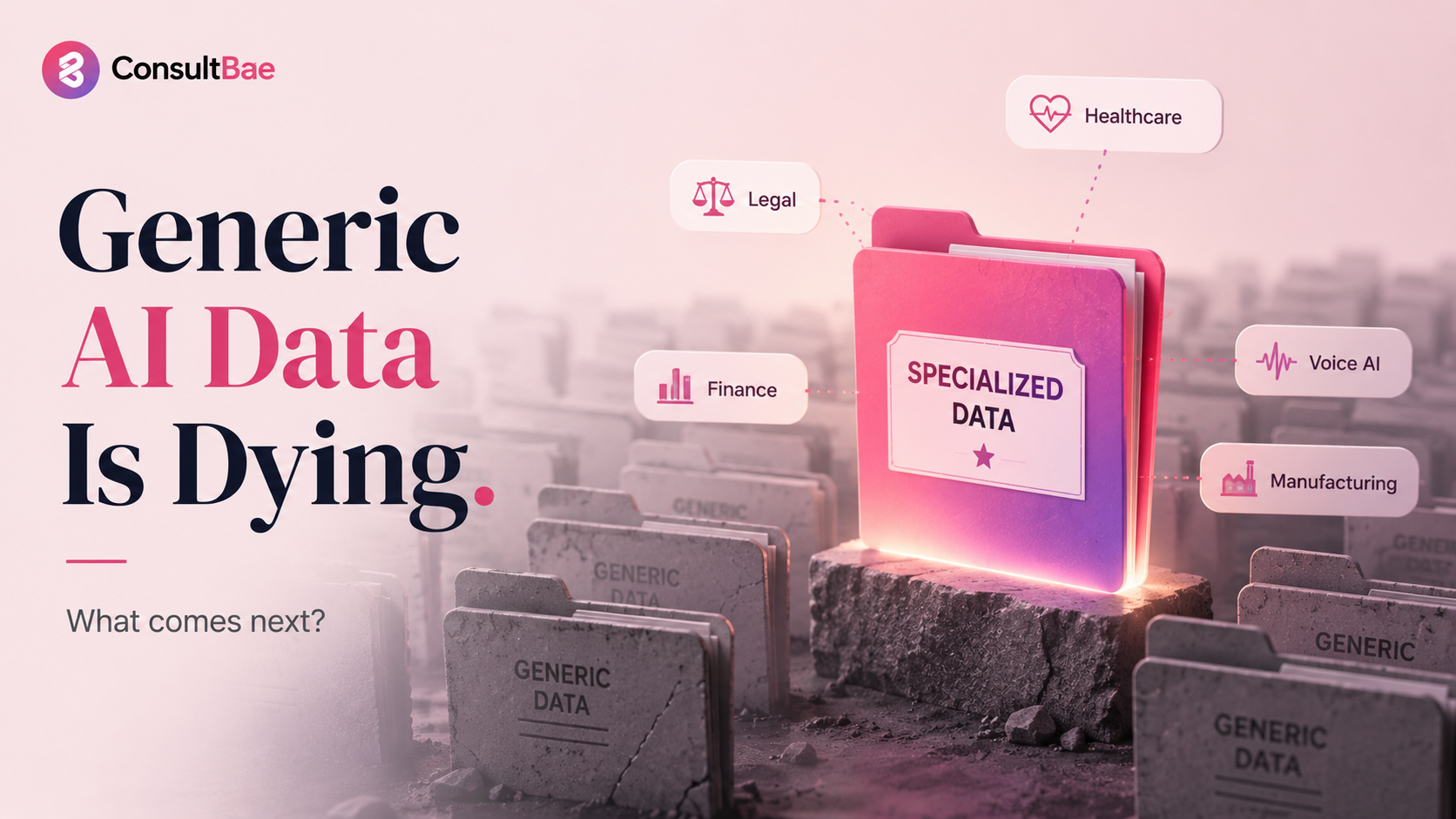
Generic data collection has already been done. Whatever remains of it will be obsolete within two years. The industry knows this. The briefs we are receiving now tell the whole story.
Why the first wave is ending
The logic of the first wave was volume. Large language models needed enormous quantities of human-generated data: speech samples across languages, image sets across geographies, text annotated for tone, intent, and accuracy. The companies that could source the most data, in the most languages, across the most countries, won. Speed and scale were the differentiators.
That logic is running out of road for a simple reason. The models have consumed most of the generic data that exists or can reasonably be generated. Feeding more of the same into training pipelines produces diminishing returns. The researchers and engineers building these systems know this. The briefs we receive today look nothing like the briefs we received two years ago.
Two years ago, a client would specify a language and a volume. Send us 500 Telugu speakers. Get us 1,000 hours of Swahili audio. Today, the same clients are specifying a domain. They do not want 500 Hindi speakers. They want cardiologists who speak Hindi. They do not want 1,000 English annotators. They want annotators who understand financial regulation well enough to evaluate whether an AI-generated summary of a legal clause is technically accurate. The requirement has moved from quantity to qualification.
The two waves that replace it
From two years of running projects at this scale, we can see two distinct directions replacing the generic volume model.
The first is physical AI training. Robotics is moving from research into commercial deployment. The companies building autonomous systems, whether in manufacturing, logistics, or service environments, need training data that does not exist in any existing database. They need humans to perform physical tasks in front of cameras so the machine can learn the motion, the spatial logic, and the contextual cues behind what it is watching.
This type of data collection cannot be done remotely. It requires people in physical spaces performing controlled activities, recorded under specific conditions, across multiple locations and demographics. It requires coordination infrastructure across geographies. It requires project management that operates at the intersection of logistics and data quality. That combination of capabilities is not easy to build, and most annotation platforms are not built for it.
The second is specialist domain data. AI is moving into verticals. Medical AI. Legal AI. Financial AI. Agricultural AI. Each of these requires training data that reflects genuine expertise, not just human-generated text. A radiologist's interpretation of a scan carries information that a crowd worker pressing buttons cannot produce. A contracts lawyer reviewing an AI-generated clause summary brings judgment that only comes from years of practice. The models being built for these verticals need annotators who actually know the domain.
This is where a pool of subject matter experts becomes genuinely valuable. We have built a network of specialists across more than 50 countries and more than 40 domains, spanning technology, medicine, law, finance, agriculture, and more. These are people with real credentials and real domain experience. The same pool that has supported e-learning content development is now being deployed for specialist AI annotation work. The requirement coming from the AI industry is essentially the same: find us people who genuinely know this subject.
Two years ago: "We need 1,000 hours of Bengali speech data. Can you deliver in 30 days?"
Today: "We are training a medical AI for rural healthcare in South Asia. We need Bengali-speaking clinicians to annotate diagnostic conversations and flag clinical inaccuracies. Domain expertise required."
The volume ask has become a qualification ask. The data is more valuable, the project is more complex, and the margin for error is much smaller.
What companies building AI should understand right now
If your data strategy is still built around volume sourcing, the runway is shorter than it looks. The market for generic crowd-sourced data is compressing. What is growing is demand for data that requires expertise to produce, and that kind of data is fundamentally harder to source.
Subject matter experts are not on freelance platforms. They are not sitting in crowd-worker pools. Getting a practising doctor or a licensed financial analyst to contribute to a training dataset requires a different approach: longer relationship cycles, credentialling and verification, project designs that respect their time and expertise. The operational model for sourcing this kind of contributor is closer to executive search than to task-based gig work.
Physical AI training adds another layer of complexity. You cannot run it from a dashboard. It needs ground-level coordination, physical infrastructure, and the ability to manage people and equipment across multiple geographies simultaneously.
These are hard operational problems. They are also the problems that will define which data partners are still relevant two years from now.
Why ConsultBae is built for what comes next
ConsultBae has been running AI data projects since before most companies were calling it that. We built the network, the sourcing infrastructure, and the project management capabilities through live delivery across hundreds of projects in more than 100 countries. We did not acquire these capabilities on paper. We built them by delivering projects that had no existing playbook.
We have the crowd and freelancer network for large-scale collection. We have the subject matter expert pool for specialist annotation work. We have the operational capacity for physical AI data collection. And we have six years of experience managing the complexity that comes with doing all of this across multiple geographies, languages, and data types simultaneously.
The generic wave is ending. The specialist wave is already here. ConsultBae is built to work in both, and in whatever comes after that.
Amitt Agrawaal is the Founder of ConsultBae. He has spent six years building ConsultBae's operations across recruitment, e-learning, and AI data collection.
Working on an AI data project?
ConsultBae handles data collection, specialist annotation, and physical AI training across 100+ countries. Let us talk about what you are building.
Get in touch