

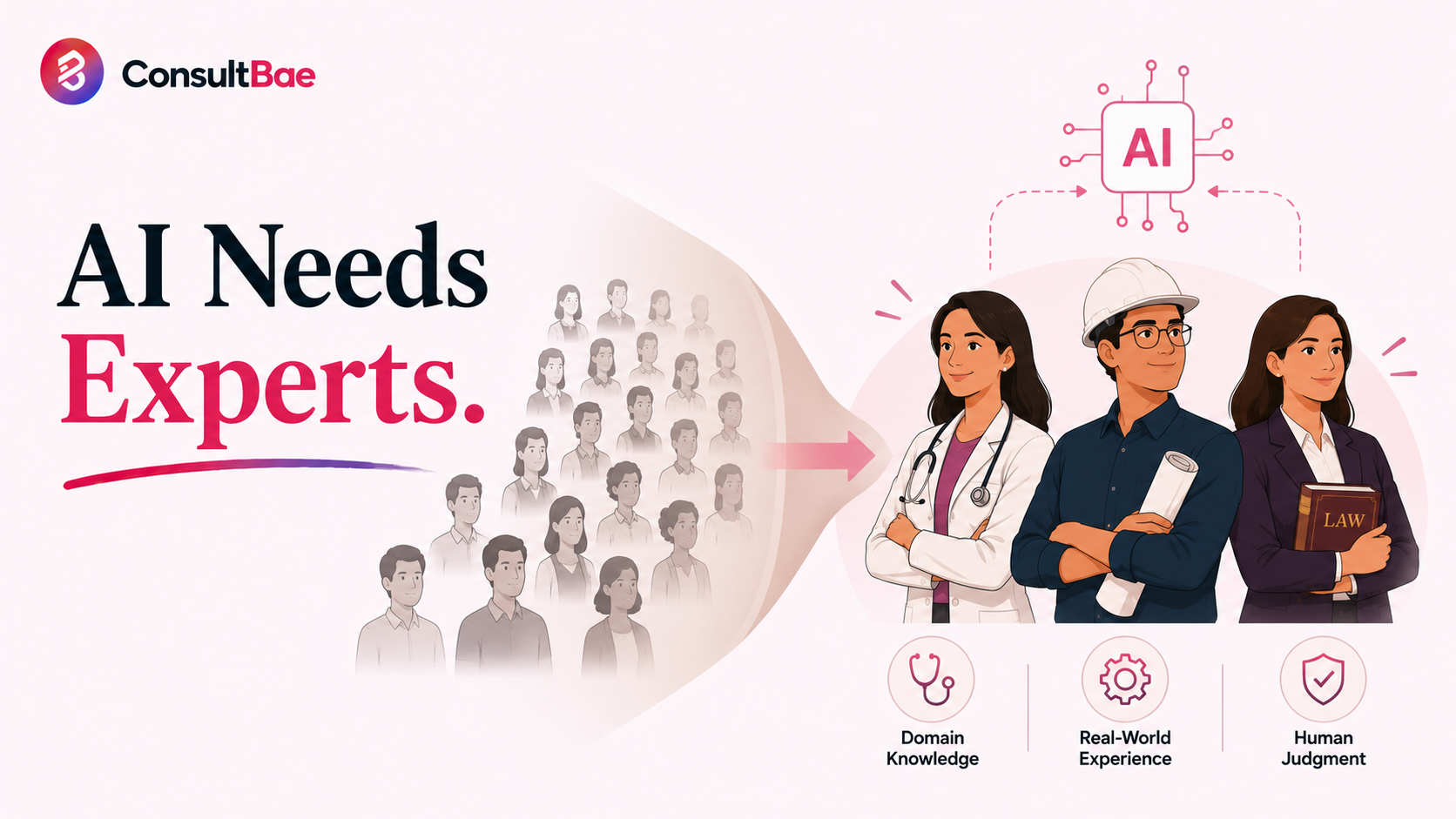
The conversation about artificial intelligence and employment tends to collapse into one of two positions: either AI will replace most human jobs within a generation, or concerns about displacement are overblown and nothing fundamental will change. Neither of these positions is particularly useful for the people who are trying to understand what is actually happening right now in the labour market for human contributors to AI systems.
We source human contributors for AI data projects across more than a hundred countries. We have been doing this for several years, across voice, image, video, and text collection, across generic and specialised annotation tasks, and increasingly into domain-expert validation work that requires specific professional knowledge rather than general availability. What we see from the inside of this market is not a story of replacement. It is a story of transformation: what is being automated, what is growing in value as a result, and where the demand for human capability is shifting rather than disappearing.
The story is more interesting than either of the popular positions suggests, and it has direct consequences for how organisations that need AI data should be thinking about the human resources required to produce it.
What the Replacement Narrative Gets Wrong
The replacement narrative, in its most common form, treats human contribution to AI systems as a single category: people doing repetitive labelling tasks that machines will eventually learn to do themselves. This is accurate for a specific subset of the work, and it is already happening. Automated quality scoring, algorithmic annotation for standard object detection tasks, synthetic data generation for well-defined training scenarios: these technologies are reducing the need for human labour on the most generic, highest-volume, lowest-judgment tasks in the AI data pipeline.
What the narrative misses is that this automation is simultaneously creating a different kind of demand. As models become more capable at generic tasks, the value in training them shifts toward the tasks they cannot yet do reliably: recognising rare edge cases, validating the accuracy of model outputs in specialised domains, providing the kind of contextual judgment that requires years of professional experience to develop. The tasks being automated are at one end of the skill and judgment spectrum. The tasks growing in value are at the other end. Treating these as the same category produces a misleading picture of what is actually happening to total human demand in AI workflows.
The more accurate picture is a bifurcation: the middle of the skill distribution, the generic, high-volume, low-judgment work, is being automated. The top of the distribution, the specialised, judgment-intensive, domain-specific work, is becoming more valuable. The people in the middle face the most disruption. The people at the top, if they can position themselves correctly, face expanding demand.
Where Human Demand Is Actually Increasing in AI Workflows
From our operational experience, the clearest growth areas in human demand for AI data work are not in volume collection but in specialised validation and domain-specific contribution. Model builders who a few years ago were primarily buying large volumes of generic speech recordings or image annotations are now asking for much more specific profiles: medical professionals who can validate clinical AI outputs, legal practitioners whose document annotation reflects actual professional judgment, engineers whose data contributions to physical AI training require hands-on expertise in the specific tasks robots are being trained to perform.
This shift is not speculative. It is visible in the project briefs arriving from clients today versus two years ago. The earlier requests were primarily demographic: we need native speakers of this language, we need images of this type of scene, we need text in this format. The current requests are increasingly professional: we need practitioners with this specific combination of domain expertise and technical familiarity, we need subject matter experts whose annotation reflects current industry practice rather than general knowledge.
The total volume of tasks being requested has not decreased. In many cases it has increased, because more sophisticated models require more carefully curated training data, not less. What has changed is the profile of the human contributors the data requires, and the sourcing infrastructure needed to find them reliably at the right volume.
"Generic data collection will get more automated in the next two years. But there are two waves coming after it. One is physical AI, where robots need human data to learn. The other is domain expertise, where the value comes from what the contributor knows, not just who they are."
The Specialisation Shift: From Generic Contributors to Domain Experts
The practical implication of the demand shift described above is that the sourcing infrastructure required to fill AI data projects is changing in character. Two years ago, the primary challenge in most data collection projects was volume and demographic coverage: finding enough people with the right language profile, the right age range, the right geographic location. This is a crowd-sourcing challenge, and it is met by crowd-sourcing infrastructure: platforms, community networks, high-volume outreach.
The emerging challenge is profile specificity at a level that crowd-sourcing cannot reliably deliver. Finding a cardiologist who uses a specific diagnostic AI tool in their daily practice, and who can annotate model outputs in a way that reflects genuine clinical judgment, is not a crowd-sourcing problem. It is a talent problem. The population of people who meet the brief is small, they are not concentrated on any platform, and they will not respond to the same outreach that works for a generic contributor recruitment campaign.
This specialisation shift has direct consequences for how AI data partnerships need to be structured. A vendor whose infrastructure is built for volume sourcing of generic contributors is not positioned to deliver the specialised domain expert profiles that model builders increasingly need. A vendor whose network spans both the crowd-sourcing layer and the professional expert layer is positioned very differently, and the combination of the two is where the most durable competitive advantage in AI data sourcing is being built today.
What This Means for How AI Data Projects Are Staffed Today Versus Two Years Ago
Two years ago, a typical AI data project brief was a demographic specification: language, age range, gender distribution, geographic location. The sourcing work was primarily about finding people who matched the profile and were willing to participate. Quality was managed through volume: collect more than you need, filter out the recordings or annotations that do not meet the standard, deliver what is left.
Today, an increasing proportion of project briefs are professional specifications. The client is not just asking for someone who speaks a language. They are asking for someone who speaks the language and works in a specific industry and uses a specific tool and has a specific level of seniority and is available for a specific type of contribution that requires their active judgment rather than their demographic presence. The difference in the sourcing approach required to fill this brief is substantial. The difference in the quality of the resulting data for model training purposes is equally substantial.
The transition from demographic to professional specification is also changing the timeline and cost structure of AI data projects. A generic contributor can be onboarded in hours. A specialist professional contributor requires a qualification process that takes days, an onboarding that communicates the specific expectations of their domain, and a relationship management approach that recognises their time is more scarce and their motivation more complex than a crowd contributor's. Projects that have made the transition to specialist profiles are generally more expensive per data point, deliver at lower volume, and produce training data whose value per unit is substantially higher.
Where the Human Layer in AI Will Continue to Grow
The two areas where the human layer in AI development will continue to expand, based on the direction of current demand, are physical AI and domain-expert validation.
Physical AI, the training of robots and physical systems that need to learn tasks through human demonstration, requires contributors who perform specific physical activities in controlled or field environments so that the movement, interaction, and environmental data can be collected at the resolution required for robot training. This type of collection cannot be automated. It requires people to do things in the physical world, captured in ways that give the training pipeline the data it needs. The scale of demand for this type of contribution is growing as robotics applications expand from controlled industrial environments into the more varied and unpredictable physical contexts that real-world deployment requires.
Domain-expert validation, the use of professional practitioners to evaluate and correct AI outputs in specialised fields, is the other growth area. As AI systems are deployed in medicine, law, engineering, finance, and other professional domains where the cost of error is high, the need for human oversight of model outputs does not decrease. It becomes more important and more specific. The practitioners who can provide that oversight, whose professional judgment is calibrated to the actual standards of their field, are not being replaced by the AI they are helping to validate. They are being sought with increasing urgency by the model builders who need their knowledge to ensure the systems perform reliably in the real world.
Domain-expert validation: Professional practitioners evaluating AI outputs in specialised fields where the cost of error is high and the judgment required reflects years of domain experience. This type of contribution grows in value as AI systems are deployed in more consequential settings. It cannot be automated because the validation itself is the application of human expertise to assess whether an automated system is performing correctly.
Physical task demonstration for robotics training: Human contributors performing specific physical tasks so that robots can learn from the demonstration data. The requirement for physical, embodied human action in specific environments and contexts means this type of collection has no automated substitute. Demand is growing as robotics applications expand into more complex real-world environments.
Contextual and cultural judgment: Human contributors whose value comes not from their demographic profile but from their understanding of how language, behaviour, and context operate in specific communities. This type of contribution is required for AI systems that need to function reliably across cultural and linguistic boundaries that are too nuanced for automated approximation to capture accurately.
The narrative of AI versus human labour is a simplification that serves neither the model builders who need high-quality human data nor the contributors who could be providing it if they understood where the real demand is moving. The jobs being automated were always the ones that required the least of the people doing them. The work that is growing in value is the work that requires exactly what AI cannot yet provide: professional judgment, embodied physical capability, and the deep contextual understanding that comes from being an expert human in a specific domain. That work is not disappearing. It is becoming the most important part of how capable AI systems get built.
Building AI Systems That Need Specialised Human Data?
ConsultBae sources and manages AI data contributors from generic demographic profiles through to domain experts across 40 plus fields, in 100 plus countries, across all four data modalities.
Talk to Our AI Data Team