A new hire's first 30 days is often discussed as a test of the hire. Did they ramp up quickly. Did they fit the team. Did they show the capability they were hired for. The framing is wrong. The first 30 days is not primarily a test of the hire. It is a test of whether the company built a process to let someone new succeed in it.
The companies with the lowest early attrition rates we work with do not have unusually talented hires. They have unusually thoughtful onboarding. They understand that the first month is when the relationship between a new employee and the organisation either gets established on a strong foundation or starts accumulating the small frustrations that compound into the conversation about leaving six months later.
What most onboarding actually delivers
A laptop on day one. Access to a few systems. An introduction to the team via Slack. A list of documents to read. Maybe a one-on-one with a manager who is genuinely glad they are there but is also stretched too thin to do more than say hello before the next meeting. By day three, the new hire is sitting at their desk wondering what they should actually be doing.
None of this is malicious. It is the default when nobody owns onboarding as a specific deliverable with a specific outcome. The hiring manager owns the hire decision. HR owns the paperwork. Nobody owns the experience of the first month from the new hire's perspective, which means it falls between the cracks and the new hire absorbs the cost.
What the first 30 days actually needs to deliver
A well-designed first month delivers four things, and the absence of any one of them creates a meaningful problem in the second month.
Context. The new hire needs to understand not just what the company does but how decisions are made, what is currently being prioritised, what the recent history is, and where their work fits into a larger picture they were not part of building. Reading documents is part of this. Conversations with people across the organisation are the bigger part.
Ownership clarity. They need to know what they are accountable for, what decisions they can make without checking, what decisions require sign-off, and from whom. Ambiguity here is one of the most consistent sources of new-hire frustration. A new hire who is unclear on their authority either over-asks and feels micromanaged or under-asks and accidentally oversteps. Both are avoidable with clarity at the start.
A first real win. Something the new hire delivered, even small, that mattered to the team. This is the most underrated part of onboarding. A new hire who has shipped something concrete in their first month feels like a contributor. A new hire who has spent four weeks in meetings and reading documents feels like a passenger, and that feeling is sticky.
Relationships with key stakeholders. The people the new hire will need to work with regularly should not be names on an org chart at the end of the first month. They should be people the new hire has had a real conversation with, ideally outside of a formal meeting. Building those relationships intentionally in the first month makes the second month significantly easier.
The new hire is not testing themselves in the first 30 days. They are absorbing information about whether this company is what they were told it was. The onboarding is the answer.
The four-week structure that consistently works
The specific structure varies by role and company, but a pattern repeats across the onboardings that consistently produce strong retention.
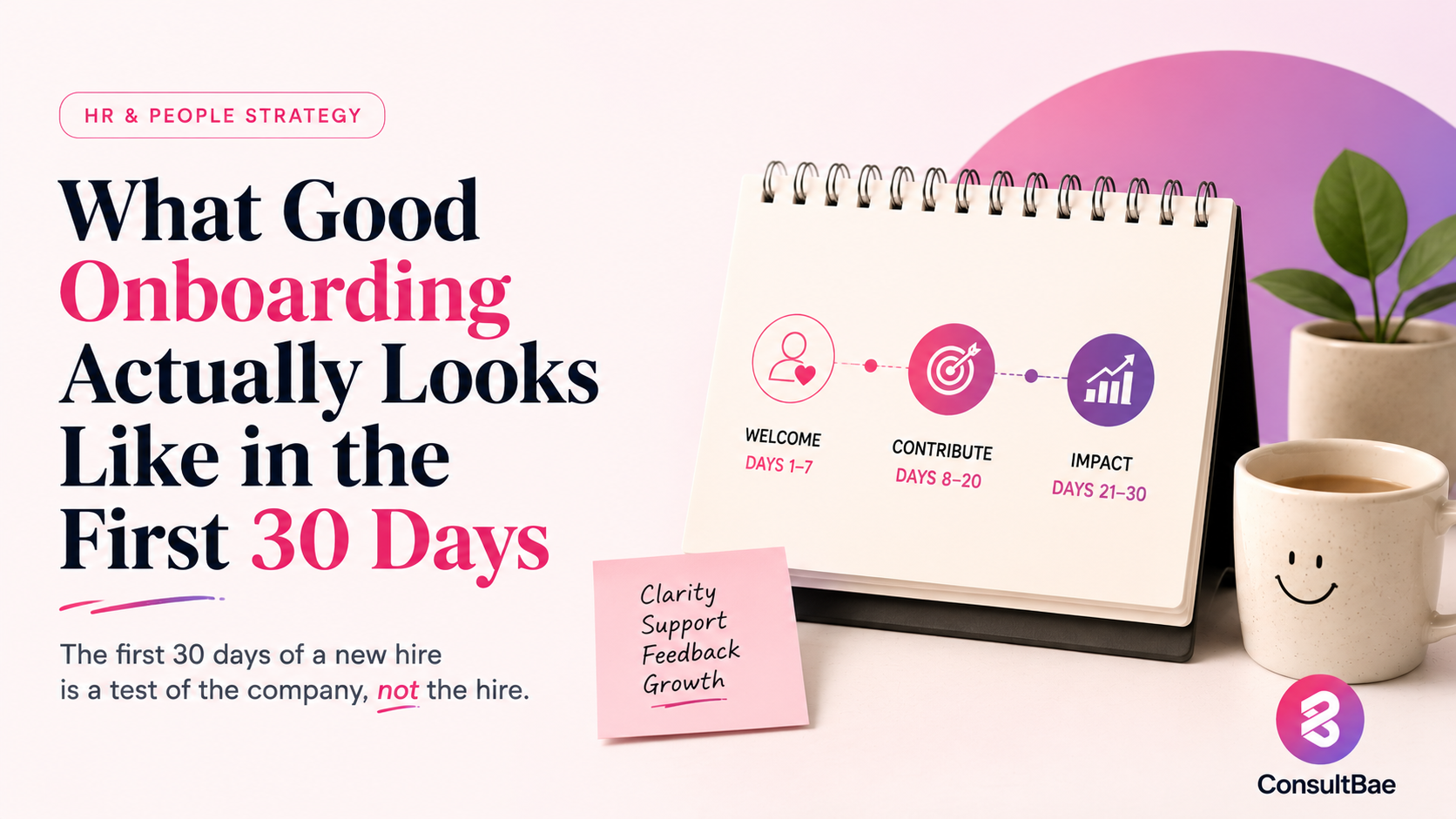
Week one is context-heavy. The new hire is meeting people, reading material, observing meetings, and asking questions. The goal is not productivity. It is comprehension of the environment they are working in.
Week two introduces a small, defined deliverable. Not a real project yet — a learning exercise that is genuinely useful to the team. This gives the new hire something to work on, surfaces specific questions, and creates the first opportunity for direct feedback.
Week three moves into a real piece of work, scoped to be achievable in the time available and clearly owned by the new hire. The manager is available for guidance but not co-owning the work. This is where the new hire starts to feel like a contributor.
Week four is reflection and forward planning. What worked, what was confusing, what the new hire needs to be effective beyond the first month, and what the goals for the next 60 days are. The conversation is two-directional — the new hire's feedback on the onboarding is at least as important as the manager's feedback on the new hire.
What managers can do that costs nothing and matters most
The single highest-leverage thing a hiring manager can do in a new hire's first month is be available. Not in scheduled one-on-ones — those are necessary but not sufficient. Available in the small unscheduled moments when the new hire has a question and needs an answer to keep moving. A manager who responds within an hour during the first month signals that this hire matters. A manager who takes two days to respond signals the opposite, regardless of intent.
The second highest-leverage thing is direct, specific early feedback. New hires want to know how they are doing, and ambiguity creates anxiety that affects their work. Five minutes at the end of the first week to say "here is what is going well, here is what to adjust" is worth more than any formal review later.
The new hire knows what they own and what they do not. They have shipped at least one concrete piece of work. They have working relationships with the people they need to coordinate with. They have a clear view of what success looks like for the next 60 days. They have received direct feedback on their early work. And they have given honest feedback about the onboarding itself.
If any of these is missing, the second month will be working around the gap rather than building on the foundation.
How ConsultBae thinks about this
At ConsultBae, we see both ends of the hiring process: the placements that hold and the ones that do not. The single most reliable predictor of which is which is not the candidate, the role, or the compensation package. It is the onboarding the new hire walks into.
We have placed candidates at companies with excellent onboarding and watched them thrive. We have placed equally strong candidates at companies with poor onboarding and watched them leave within a year. The candidates were not the variable. The first 30 days was.
When we work with clients on hiring, we sometimes raise this directly. The hire we place will succeed in proportion to how well the company has prepared to receive them. If the onboarding is an afterthought, the placement is at risk before it begins. Getting this right is one of the highest-leverage things a hiring manager can do, and it costs almost nothing except thought and attention upfront.
Anubhav Sahay is part of the hiring team at ConsultBae, focused on mid-to-senior recruitment for funded startups across India.
Want your next hire to actually stay?
ConsultBae works with funded startups on hiring and the onboarding that determines whether placements hold. Let us talk.
Talk to us