There is a version of the staffing relationship story that ends at placement one. The role was filled, the invoice was paid, both sides move on. For a lot of firms and a lot of clients, this is the only version that ever plays out. The engagement is transactional by design, and nobody involved has done the work to make it anything else.
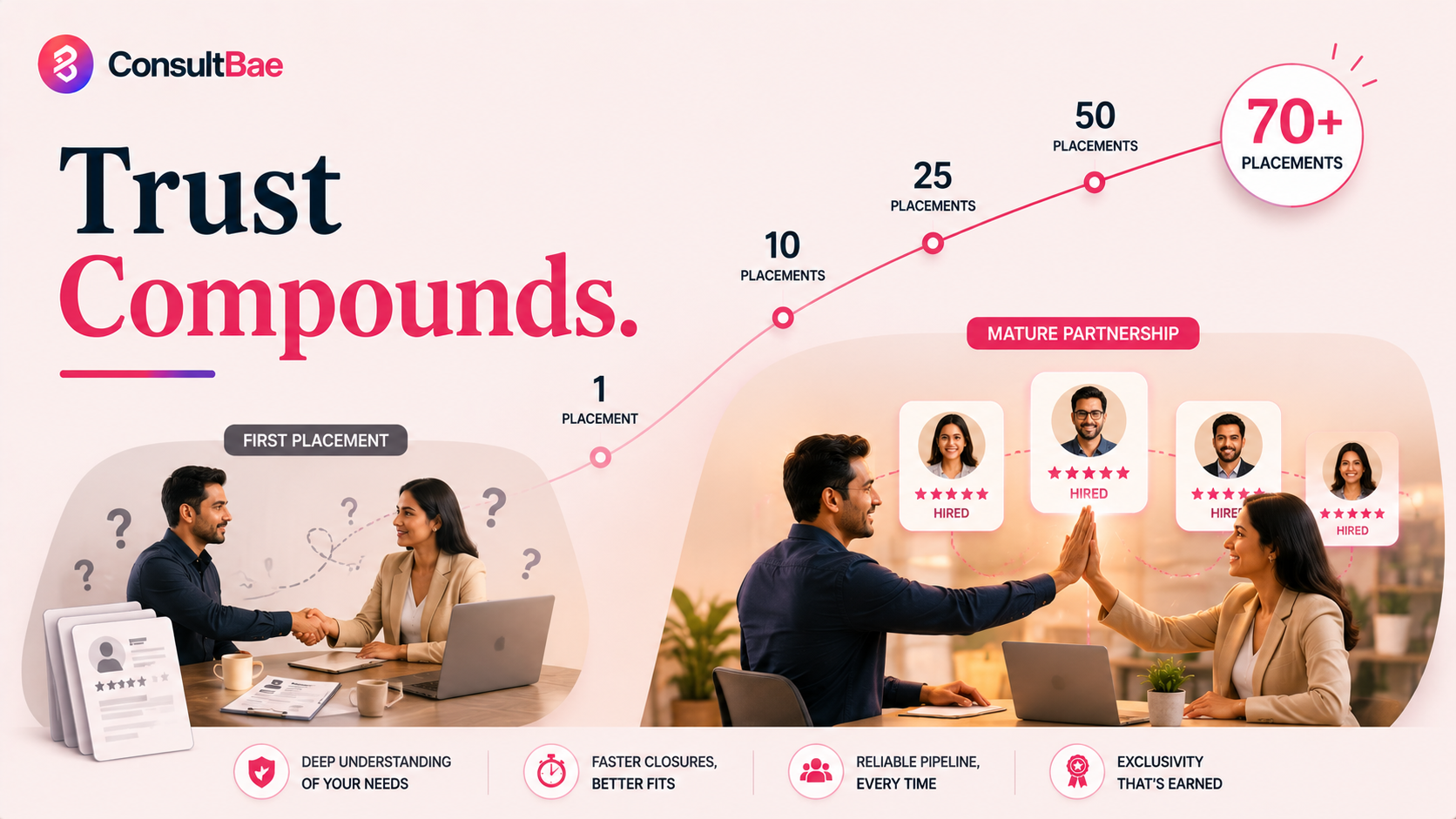
The more interesting story, and the one that actually builds something durable, begins somewhere around placement ten. By that point, the recruiting firm knows the client's culture well enough to screen without asking. The client knows the firm's process well enough to trust the shortlist without interrogating it. The relationship has developed a kind of institutional memory that reduces the friction of every subsequent engagement and makes both sides meaningfully more effective than they would be working with someone new.
Over two years and more than seventy placements with a single US-based technology client, we learned what this arc looks like in practice. What gets built, what stays fragile, and what it takes to move from a vendor a client tolerates to a partner a client relies on.
What Changes Between Placement One and Placement Fifty
The first placement in any new client relationship carries the most uncertainty and the most effort for the lowest output. The recruiting firm does not yet know which aspects of the job description are real requirements and which are aspirational. They do not know the internal culture dynamics that will make a technically qualified candidate a poor fit in practice. They do not know who the actual decision-makers are versus the nominal ones, or how quickly the client's internal process moves once a good candidate is in front of them.
All of this has to be discovered through the first several engagements. It takes time, it takes communication, and it takes a recruiting firm that is paying close enough attention to learn from each placement rather than treating each one as an isolated transaction. By placement ten, the firm has a working model of the client that is more accurate than any briefing document could produce. By placement twenty, they are anticipating needs before the client articulates them.
This accumulated knowledge is the primary asset of a mature staffing relationship. It is also non-transferable. A client who switches partners at placement fifteen is not just starting a new relationship. They are giving up the fifteen placements worth of institutional knowledge their existing partner has built, and paying the cost of the new partner's learning curve in slower closures and more misaligned shortlists before the new relationship reaches the same calibration.
How Trust Gets Built in a Staffing Relationship Over Time
Trust in a staffing relationship is not a single event. It is not built by one excellent placement, however impressive. It is built by consistency across many placements, including the ones that are difficult. The placements where the original brief turns out to be wrong and the firm adapts without blame. The placements where a candidate who looked right turns out not to be, and the firm handles the replacement quickly and without defensiveness. The placements where the client changes the requirements mid-process and the firm absorbs the change without losing the timeline.
What these situations reveal is not whether the firm is capable when conditions are ideal. They reveal whether the firm is a reliable partner when conditions are not ideal, which is most of the time in a scaling technology company whose hiring needs are constantly outpacing its ability to define them precisely. The firms that handle difficult placements well earn disproportionate trust, because difficult placements are when the difference between a vendor and a partner becomes most visible.
"Pipeline is always healthy. That is the only fundamental thing. If you have a good pipeline, the chances of closing are higher. And for a client who trusts the pipeline, the relationship compounds every time a role opens."
The Moment a Client Stops Evaluating and Starts Relying
There is a recognisable inflection point in a long-term staffing relationship where the client's posture shifts. Before the inflection, every new role opens with the client in evaluation mode: scrutinising the shortlist, asking clarifying questions about why each candidate was included, comparing the quality of this submission to the last one. After the inflection, a new role opens and the client sends the brief without asking whether the firm can handle it. The question of capability has been settled. The question now is only speed and fit.
This shift is visible in the texture of the communication. Briefing conversations get shorter because less context-setting is required. Feedback on shortlists gets more specific and less defensive because the client trusts that any pushback will be taken seriously and acted on. The relationship becomes more collaborative and less supervisory because both sides have established enough shared reference points to operate with less friction.
For the recruiting firm, this inflection is when the relationship becomes genuinely efficient. The cost of each placement in terms of relationship management time drops. The conversion rate from shortlist to hire improves because the calibration is better. The partnership starts producing output that neither side could achieve with a new relationship at the same investment level.
What Exclusivity Means and How It Gets Earned
Exclusivity in a staffing relationship means the client has decided to route all or most of their hiring through a single partner rather than working with multiple firms simultaneously. It is the highest expression of the trust arc described above, and it is worth understanding clearly because it is frequently misunderstood.
Exclusivity is not a contract term that a firm negotiates into an agreement. It is a status that a firm earns by consistently demonstrating that they can deliver what the client needs, at the speed the client needs it, with less effort from the client's side than managing multiple vendors would require. A client who is working with three staffing firms simultaneously is doing so because no single firm has given them sufficient confidence to consolidate. The moment one firm establishes that confidence, the others become redundant.
Becoming the exclusive partner for a client who has historically used multiple firms is not won by pitching exclusivity as a concept. It is won by filling roles faster and with better-calibrated candidates than the competition over enough engagements that the client does the math themselves and reaches the obvious conclusion.
What Keeps a Long-Term Staffing Relationship Healthy
Long-term staffing relationships have a failure mode that does not exist in short ones: complacency. The accumulated trust that makes a mature partnership efficient can also make it comfortable in ways that reduce the urgency that produced the results in the first place. The firm starts presenting fewer candidates per role because the historical conversion rate has been good. The client stops providing detailed feedback because the relationship feels settled. Both sides drift toward the path of least resistance, and the quality of the partnership gradually declines below the threshold that justified the exclusivity in the first place.
The antidote is deliberate maintenance. Regular conversations that are not triggered by an open role, where both sides review what is working and what is not. Proactive sharing of pipeline intelligence from the firm's side: shifts in candidate availability, salary benchmarks, new profiles that match the client's likely future needs even before those needs are formally articulated. Continued investment in the sourcing infrastructure that produced the results, rather than coasting on the database that was built when the relationship was new.
Maturing well: The client briefs new roles with less context because the shared understanding is strong enough to fill the gaps. Feedback cycles shorten. The firm proactively surfaces candidates for roles the client has not yet opened. Conversion rates from shortlist to hire improve over time.
Plateauing: The firm submits the same types of profiles regardless of how the client's needs have evolved. The client stops providing detailed feedback because the relationship feels settled rather than because calibration is excellent. New roles open and close on the same timeline as year one, with no improvement from the accumulated knowledge of the partnership.
The difference between these two trajectories is usually the level of active investment from both sides in keeping the relationship forward-looking rather than letting it operate on inertia.
The staffing relationships that last two years and produce seventy placements are not accidents. They are the result of consistent delivery, honest communication when things go wrong, and a deliberate decision by both sides to invest in the relationship rather than just the transaction. The investment compounds. The transaction does not.
Looking for a Staffing Partner Built for the Long Term?
ConsultBae builds recruitment and staffing relationships designed to compound over time, with a three-team structure that maintains speed and quality across the full lifecycle of a partnership.
Talk to Our Hiring Team