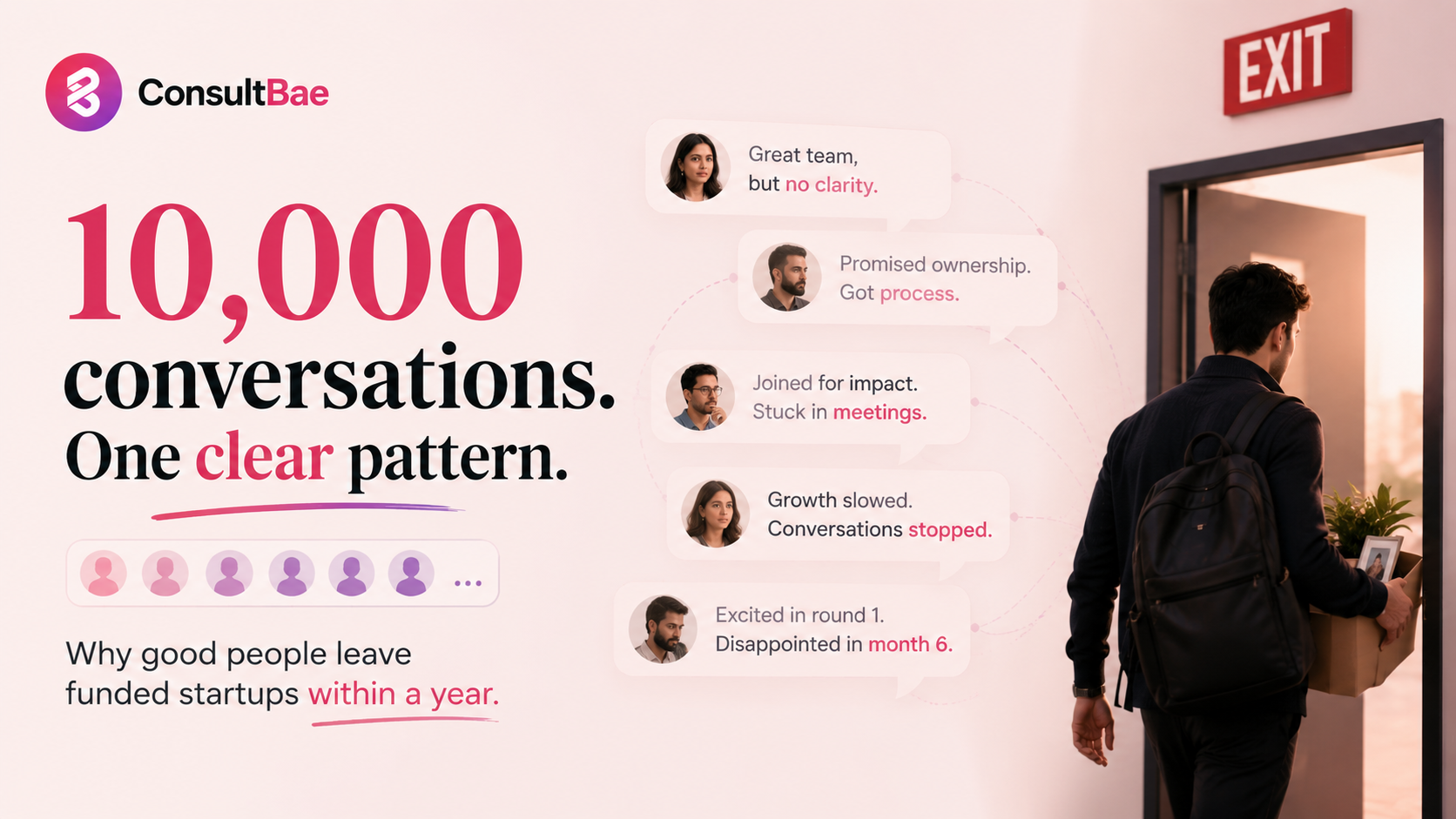
Over the course of placing mid-to-senior candidates at funded startups, our team has been in an estimated 10,000-plus conversations with people who were either considering a move, in the middle of one, or reflecting on why a move they had made did not work out. Those conversations accumulate into something useful: a clear picture of why early attrition at funded startups happens as often as it does, and why the cause is almost never what the company believes it to be.
When a good hire leaves within a year, the internal explanation is usually about the candidate. They were not the right fit. They were not ready for the pace. They had unrealistic expectations. Sometimes that is true. More often, from where we sit, the real explanation is simpler and more uncomfortable: the hiring process created a gap between what was promised and what existed, and the candidate spent their first year discovering that gap.
It is almost never about the compensation
The first thing most founders reach for when a hire leaves early is compensation. They were poached. They got a better offer. Someone paid more. In our experience, this explains a small fraction of early exits. Candidates who leave primarily for money usually signal that during the process. The ones who leave within a year and surprise their employer almost always leave for something else.
What they leave for, consistently, is a mismatch between expectation and reality in areas that are harder to quantify than salary. The work itself. The decision-making environment. The people. The stage of the company relative to how it was described. These are the things that determine whether a good candidate stays and builds, or quietly starts looking again six months in.
Candidates do not leave jobs. They leave the version of the job they were sold that turned out not to exist.
The five patterns that come up most
Across thousands of post-exit and mid-tenure conversations, five mismatches surface more than any others.
Ownership that existed on paper but not in practice. A candidate was hired to own a function. The job description said so. The founder said so in three rounds of interviews. They joined and found that every significant decision still routed through the founder, that their mandate had invisible limits, and that ownership in this company meant accountability without authority. This is the single most common pattern we see at Series A and B companies where the founder has not yet made peace with delegation.
A roadmap that was described as clear and turned out to be a conversation. Candidates at the mid-to-senior level are joining to build something specific. When they ask about roadmap in interviews, they get a confident answer. When they join, they find that the roadmap is actually under active debate, that priorities shift every quarter, and that what they were hired to build is not yet decided. This is not inherently a problem at an early-stage company. It becomes one when it was not disclosed during hiring.
Culture described in the interview that did not survive contact with the actual team. Every funded startup describes its culture in roughly the same terms: fast-moving, collaborative, high ownership, low hierarchy. Sometimes that is accurate. Often it is aspirational. The candidate joins expecting one environment and finds another. Not necessarily a bad environment, just a different one. The mismatch is enough to break the initial commitment within months.
Compensation structures that looked good on paper and felt different in practice. ESOPs explained without context. Variable components presented optimistically. Appraisal cycles that work differently than described. None of these are necessarily deceptive on their own. Together, they create a candidate who joined with a specific expectation of total earnings and found the reality materially different within the first year.
Team quality that was not what the hiring conversation implied. A senior hire joins expecting to work with a capable team they can build with. They find a team that is stretched thin, under-resourced, or operating below the level they were led to expect. The senior hire spends their first months doing work they thought they were being hired to oversee, gets frustrated, and starts to disengage.
Replacing a mid-to-senior hire typically costs between 50% and 150% of their annual salary when you account for recruitment fees, onboarding time, productivity loss during the gap, and the drag on team morale that visible early attrition creates.
At Series A and B, where every senior hire is supposed to compound the team's capability, an early exit does not just cost money. It costs six to twelve months of the trajectory that hire was supposed to accelerate.
In almost every case we have seen, the failure traces back to something said or left unsaid during the hiring process.
Why funded startups specifically have this problem
Early-stage companies hire under pressure. There is a round to close, a product to ship, a team to build before the runway runs out. Speed creates incentives to present the company in the best possible light and leave the harder truths for the candidate to discover on their own. This is not usually malicious. It is what happens when founders who are genuinely optimistic about their company are also in a hurry.
The result is a hiring process that functions more like a sales process than a matching process. The company is selling itself. The candidate is being sold. What gets lost is the honest exchange of information that would allow both sides to make a clear-eyed decision about whether this is actually the right match.
A good candidate at the mid-to-senior level has options. They are not just evaluating whether to take this role. They are evaluating whether this company, this team, and this stage is where they want to spend the next two to three years of their career. If the information they make that decision on turns out to be incomplete, the relationship starts with a deficit it often cannot recover from.
What the hiring conversation should actually look like
The companies with the lowest early attrition rates we have worked with share one quality: they are honest about the hard parts before the offer goes out. Not performatively honest, not listing every problem in a way designed to make themselves look self-aware. Actually honest. The roadmap is uncertain here, and this is why. The founder is involved in decisions at this level, and this is how that works in practice. The team has these gaps right now, and this is the role this hire will play in closing them.
Candidates who join with accurate expectations of the hard parts are far more likely to stay and navigate them. Candidates who join with a polished version of the company discover the hard parts on their own, usually in their first ninety days, and have to decide whether they want to stay for a job that is different from the one they accepted.
How ConsultBae approaches this
At ConsultBae, our job is not to fill a role. It is to make a match that holds. That means preparing candidates for what they are actually walking into, including the parts the company did not volunteer, and it means advising founders to have the honest conversations during the process rather than after the offer is signed.
The best placement is the one where both sides knew exactly what they were agreeing to, made a clear decision, and started with aligned expectations. Those hires stay. They build. They become the people a company talks about when it describes how it scaled.
The 10,000 conversations point to the same conclusion every time. Honesty in hiring is not a risk. It is the most reliable way to get a hire that actually works.
Anubhav Sahay is part of the hiring team at ConsultBae, focused on mid-to-senior recruitment for funded startups across India.
Hiring mid-to-senior talent for your startup?
ConsultBae specialises in placing the right people at funded startups — and making sure the match actually holds.
Talk to us