

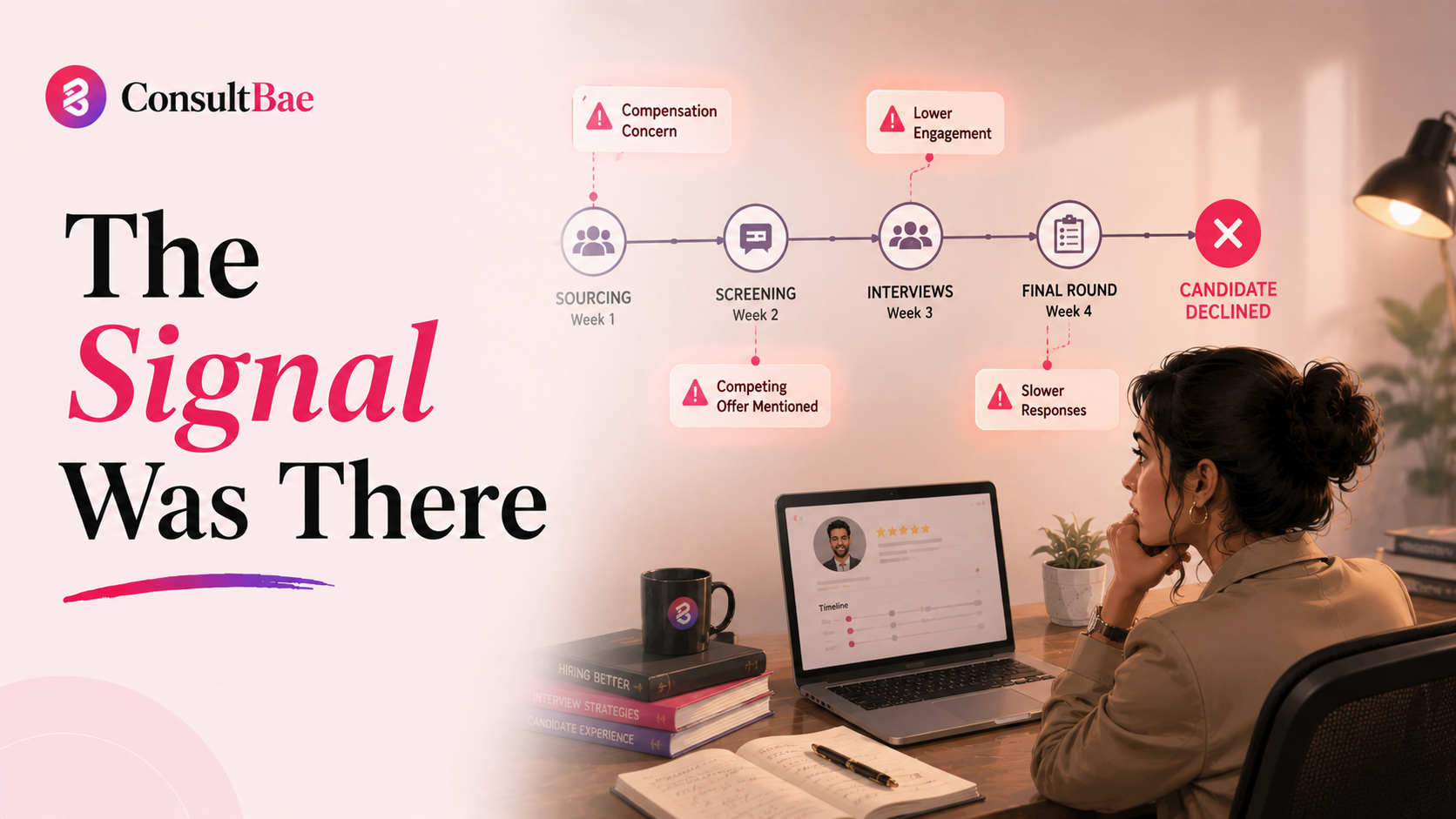
The candidate had been engaged throughout. First-round interview went well. Second round went better. The hiring manager was positive. Three weeks of process, all moving in the right direction. And then the offer went out and the candidate said no.
This is one of the most expensive outcomes in a recruitment process, and it is not random. Late-stage candidate declines almost always have a traceable cause, and that cause almost always produced a signal earlier in the process that was either not noticed or not acted on. The three weeks were not wasted by the decline. They were wasted in the weeks before the decline, when the process had the information it needed to either prevent the outcome or accelerate the decision before more time was spent.
Understanding why candidates decline at the offer stage, and what each cause looks like earlier in the process, is one of the most practically useful things a recruitment operation can build into its account management function.
The Four Most Common Causes of Late-Stage Candidate Decline
The first and most common cause is the competing offer. The candidate entered the process while actively interviewing elsewhere, which is entirely normal for mid-senior professionals who are in demand. During the three weeks of process, a competing role moved faster or produced a better offer. The candidate accepted the other role and declined yours. This is not a failure of the candidate's interest or commitment. It is a predictable outcome of a search process that took longer than the candidate's availability window required.
The second cause is a compensation gap that was never surfaced. The candidate had a number in mind that the role could not meet, but no one asked the right question early enough to establish whether the gap was bridgeable or not. Both sides spent three weeks on a process that was always going to end in a no because the fundamental commercial terms were never aligned.
The third cause is a culture or role fit concern that developed during the process. Something the candidate learned in the second interview or in the hiring manager conversation created a doubt about whether the role was right for them. They did not raise it during the process because the question was not asked in a way that invited an honest answer. The doubt accumulated and became the reason for the decline when the offer arrived and the candidate had to make a final decision.
The fourth cause is an external change in the candidate's circumstances: a counter-offer from their current employer, a family or personal situation that changed their availability, a change in their professional direction that made the role less relevant to where they now wanted to go. This category is the hardest to predict and the least preventable, but it is also the least common of the four. Most late-stage declines fall into the first three categories, which are all significantly more manageable.
When the Competing Offer Problem Starts, Not When It Surfaces
The competing offer problem does not start when the candidate calls to say they have accepted another role. It starts at the first conversation, when the candidate is simultaneously engaging with multiple processes and the recruitment partner does not have a clear picture of where this role sits in the candidate's priority order.
An account manager who asks the right questions in the first conversation knows whether the candidate is actively interviewing elsewhere, approximately how many processes they are in, and how the role in question compares to their other options in terms of the factors that matter most to them. With this information, the recruiter can make an informed recommendation about process pace: if the candidate has a competing process that is two weeks ahead, moving slowly is likely to result in a lost candidate regardless of how good the fit is. If the candidate is genuinely prioritising this role above others, a measured pace is appropriate.
Without this information, the process runs at whatever pace is natural for the hiring manager's calendar, without any awareness of whether that pace is compatible with the candidate's availability window. The decline at offer stage is the discovery, three weeks late, that the window had already closed.
"A pipeline that is always healthy means we can absorb a decline without losing the role. But absorbing a decline is a cost we should be working to avoid. Almost every late-stage decline has a signal that appeared in week one. Catching it there changes the outcome."
What the Compensation Conversation Timing Does to Decline Rates
The compensation conversation is the most avoided conversation in a standard recruitment process, and its avoidance is one of the most reliable predictors of late-stage decline. Hiring managers defer it because confirming the budget early feels like it limits negotiating room. Recruiters defer it because raising it feels transactional in an early relationship-building conversation. Candidates defer it because they do not want to price themselves out of a process they are interested in. The result is that three parties all know the compensation question is central to the outcome and none of them address it directly until the offer stage, when a misalignment produces a decline that could have produced an early conversation instead.
The productive approach is to surface compensation alignment early, not as a negotiation but as a qualifying question. Is the range under discussion realistic for what the candidate needs? Not can we agree exactly on a number, but is the gap between expectation and budget small enough that a conversation could bridge it? If yes, the process continues with shared knowledge that the commercial terms are workable. If no, the process ends early, which is a better outcome than the same ending three weeks later after significantly more investment from everyone involved.
Early compensation clarity does not reduce negotiating flexibility. It reduces the probability of a fundamental misalignment being discovered after the process has run to completion. The negotiating conversation, where it happens, is more productive when it is happening between parties who both know the terms are in the right range rather than when it is happening as the first substantive conversation about compensation at offer stage.
How Pipeline Health Reduces the Cost of a Decline
Late-stage declines are less damaging to a recruitment process that maintains a healthy pipeline throughout the search than to one that produces a thin shortlist and waits to see the outcome before sourcing further. A process with a healthy pipeline treats a late-stage decline as a setback of days, not weeks, because the next-best candidates are already warm and qualified rather than needing to be found from scratch.
Pipeline health is one of the core benefits of the three-team structure that separates sourcing from screening from account management. The sourcing function runs continuously throughout the search, not just at the beginning. By the time the first candidate reaches offer stage, the pipeline behind them contains other qualified candidates who have been through initial screening and are ready to be presented if the leading candidate declines. The sourcing investment does not stop when the first strong candidate appears. It continues until the role is closed, precisely because the possibility of a late-stage decline is always present.
A thin pipeline that was built on the assumption that the leading candidate would accept is the other outcome that produces a three-week delay when a decline happens. The sourcing work that was not done during the final stages of the first candidate's process now has to be done reactively, under time pressure, with a hiring manager who is frustrated that the process has restarted. The pipeline investment made throughout is the structural protection against this outcome.
What a Process Built to Catch Decline Signals Early Looks Like
A process designed to catch decline signals early has three specific elements that a standard recruitment process typically does not prioritise with the same rigour.
The first is a structured first-conversation framework that surfaces the information needed to manage the process correctly. Not a formal interview, but a qualifying conversation that establishes where this role sits in the candidate's priorities, what their compensation expectations are, whether they are actively interviewing elsewhere and how those processes are progressing, and what would need to be true about this role for them to prioritise it above their other options. This conversation takes fifteen minutes and produces information that changes every subsequent decision in the process.
The second is regular pulse checks throughout the process, not just at formal interview stages. A brief conversation with the candidate between rounds that asks honestly how they are feeling about the role, whether anything in the process has raised questions they have not yet had the chance to ask, and whether their external situation has changed since the previous conversation. These conversations take five minutes and are the mechanism by which concerns that would otherwise accumulate into a decline are surfaced and addressed while there is still time to address them.
The third is a compensation alignment check before the offer is formally prepared. This is not the offer negotiation. It is a confirmation that the number being prepared is in the range that the candidate has indicated they would accept, and that neither party will be surprised when the offer arrives. A candidate who is surprised by an offer number is a candidate who may decline reflexively even when the number is close to their expectation, because the surprise itself produces a negative response. The pre-offer alignment conversation removes the surprise and converts the offer stage from an announcement into a confirmation of something already agreed in principle.
Competing offer: The earliest signal is the candidate's answer to whether they are interviewing elsewhere and how those processes are progressing. A candidate with multiple active processes at an advanced stage has a short availability window. The process pace needs to reflect this or the outcome is predictable.
Compensation gap: The earliest signal is avoidance of the compensation conversation. A candidate who deflects questions about expectations or gives an unusually vague range is often uncertain whether the role can meet their number. The earlier this is surfaced directly, the less time is spent on a process that cannot close.
Role or culture fit concern: The earliest signal is a reduction in the candidate's engagement energy between rounds. A candidate who was enthusiastic in round one and noticeably less engaged in round two has encountered something that raised a concern. Asking directly whether anything in the process has raised questions they have not yet had answered will surface the concern when it is still early enough to address it.
External circumstances: The earliest signal is often a change in the candidate's responsiveness or scheduling flexibility that does not have an obvious professional explanation. This category is the least predictable and the least preventable, but early awareness of a change in the candidate's circumstances allows the recruiter to manage the process accordingly rather than being caught by the decline at offer stage.
The late-stage decline that follows three weeks of process is painful because of the time cost. It is more painful because almost every version of it was avoidable. Not by being lucky, but by building the process around the information that was available from the first conversation and acting on that information rather than running a standard process and hoping the natural outcome is a yes.
Looking for a Recruitment Partner Who Catches Problems Before They Cost You Weeks?
ConsultBae builds early-signal management into every search, with structured first conversations, continuous pipeline health, and pre-offer alignment checks that reduce late-stage decline rates and close roles within two weeks.
Talk to Our Hiring Team