

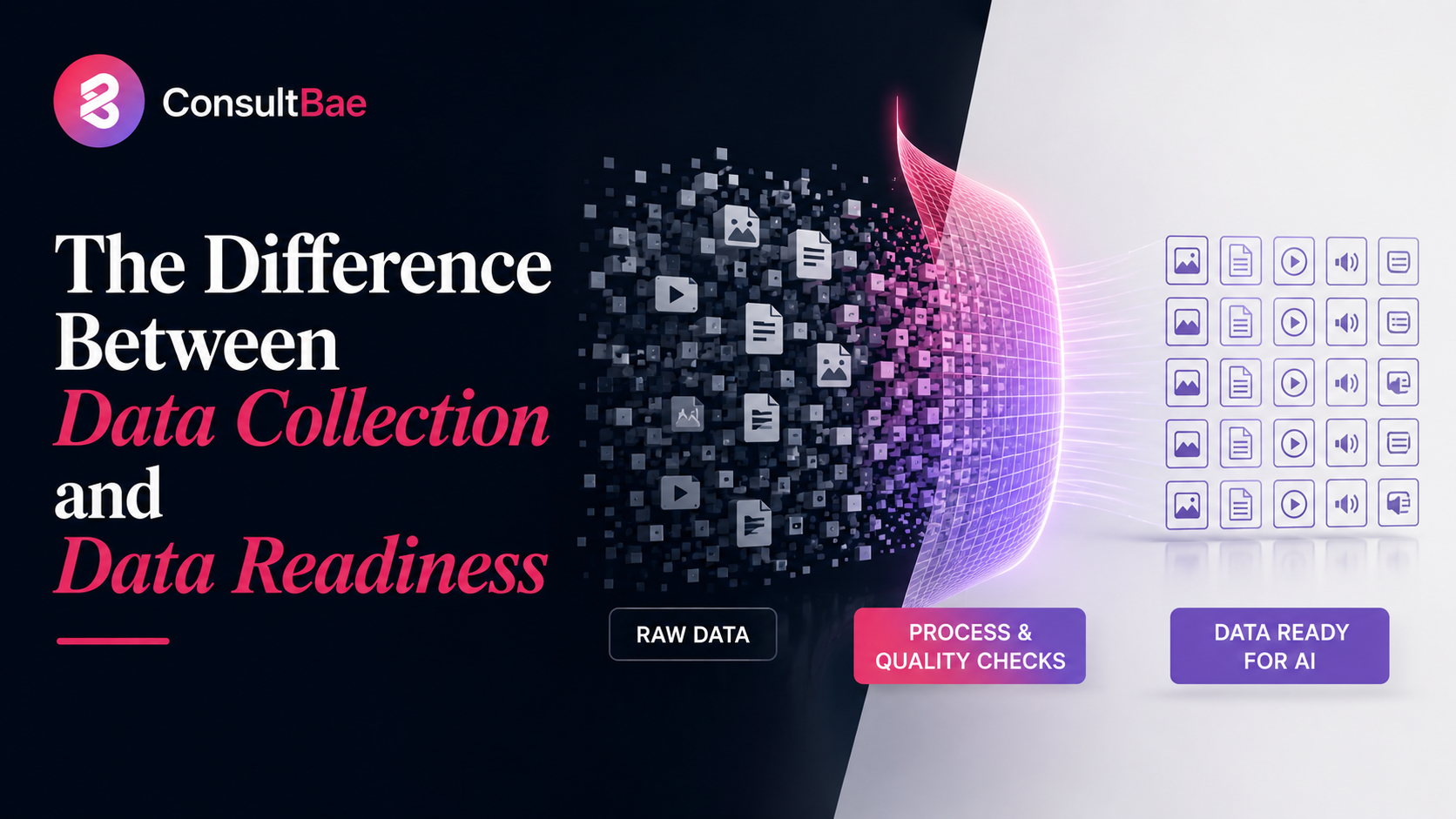
When an AI team scopes a data project, the conversation almost always centres on collection. How many samples do we need. Which languages or geographies. What modality. How fast can you deliver. These are real questions and they matter. But they are also the easier half of the problem, and treating them as the whole problem is why so many datasets arrive at training in a state that makes them effectively unusable.
Data collection is logistics. You define what you need, you find the people or environments that can provide it, you run the collection process, and you end up with raw data. That part is solvable with scale and operational competence. Data readiness is a different problem entirely. It is about whether the data you collected can actually be consumed by a model in a way that produces reliable learning. And that depends on a set of conditions that collection alone does nothing to guarantee.
What data readiness actually requires
A training-ready dataset is not just a clean dataset. It is a dataset where every element has been prepared to the specification the model needs, consistently, verifiably, and at a quality level that holds up across the full volume.
That means annotation guidelines that are precise enough that two different annotators working independently will label the same data point the same way. It means metadata that is complete and correctly formatted, because a missing field in ten percent of your records does not mean ten percent of your data is slightly imperfect. It means the gap between what the model expects and what it receives is zero, not close to zero.
It also means quality review that is built into the pipeline, not bolted on at the end. A single review pass at delivery catches some problems. It does not catch the ones that compound across thousands of records because an annotation guideline was ambiguous on a specific edge case that nobody noticed until the dataset was ninety percent complete.
Collection gives you raw material. Readiness determines whether that material is usable. Most teams invest heavily in the first and treat the second as a checklist item.
Where datasets actually break down
In practice, there are five places where a dataset that looked complete on delivery turns out to be unusable at training.
Inconsistent labelling. Annotation guidelines that are clear for common cases often leave edge cases undefined. Annotators fill the gap with individual judgment. The result is a dataset where the same type of data point has been labelled differently depending on who handled it. At small volumes this is a nuisance. At scale it degrades model performance in ways that are difficult to trace back to the source.
Format mismatches. The team collecting the data used one file format, naming convention, or metadata structure. The training pipeline expects another. This sounds like a minor technical issue. In practice, reformatting a large dataset correctly, without introducing new errors, takes significant time and creates opportunities for further data corruption.
Missing or incomplete metadata. A dataset without consistent metadata is a dataset your model cannot contextualise properly. Speaker demographics for a speech dataset. Capture conditions for an image dataset. Source information for a text dataset. When these fields are missing or inconsistently populated, the dataset loses much of its value for training models that need to generalise across conditions.
Class imbalance that was not caught during collection. If the collection design did not explicitly manage for distribution across categories, you frequently end up with a dataset that is heavily skewed toward easy or common cases. The model trains well on what it sees most often and fails on everything else.
Quality drift across the dataset. Collection projects that run over weeks or months often see quality degrade over time. Early batches were reviewed carefully. Later batches were reviewed faster because of timeline pressure. The dataset is technically complete but inconsistent in ways that the headline QA metrics do not surface.
Annotation guidelines reviewed for edge cases before collection starts, not after the first batch reveals problems.
Inter-annotator agreement checks run during collection, not just at the end, so guideline gaps are caught and corrected while there is still time to fix the affected data.
Metadata schema defined and validated against the training pipeline's requirements before a single record is collected.
Distribution monitoring built into the collection process so class imbalance is corrected in real time rather than discovered after delivery.
Multi-stage QA with different review criteria at each stage, so different failure types are caught by the review level designed to catch them.
Why this keeps happening
The reason data readiness problems are so common is not that AI teams do not understand the importance of data quality. Most do, at least in principle. The problem is organisational. Collection has a clear owner, a timeline, and a delivery milestone. Readiness is treated as part of collection when it is actually a separate discipline with its own requirements, its own failure modes, and its own timeline.
When a data project is scoped and budgeted, collection gets the attention because it is the visible, quantifiable part. The number of hours, the number of images, the number of languages. Readiness requirements get underspecified because they are harder to define upfront and easier to assume will be handled as part of the delivery process.
They are not. Not reliably. Not without explicit design.
What it costs when readiness fails
The immediate cost is the time and budget required to remediate a dataset that arrived unusable. Depending on the problem, that means re-annotation of affected records, reformatting, gap-filling on missing metadata, or in the worst cases, going back to collection for additional data to correct a distribution problem.
The downstream cost is harder to quantify but usually larger. A model trained on a dataset with readiness problems will underperform in production in ways that are difficult to diagnose. The model looks acceptable in testing, because testing conditions often mirror the common cases the dataset over-represents. It falls apart on the edge cases the dataset handled inconsistently. By the time that becomes visible, the organisation has built on top of a model that has a structural problem in its training data.
Fixing that problem at the model level is expensive. Fixing it at the data level before training is a fraction of the cost. The window for doing it cheaply is during the data project, not after.
How ConsultBae approaches this
At ConsultBae, data collection and data readiness are not two separate handoffs. They are designed as a single pipeline from the start. Annotation guidelines are stress-tested against edge cases before collection begins. Quality review is built into the collection process, not added at delivery. Metadata schemas are validated against training requirements upfront. Distribution is monitored and managed throughout.
The goal is not a dataset that passes a delivery checklist. It is a dataset that goes into training and stays there, because everything required for it to be usable was handled before it left our pipeline.
Collection gets you data. Readiness gets you a dataset your model can actually learn from. The distance between those two things is where most AI data projects lose time, budget, and model quality. It does not have to be that way.
Mohit Singh Katewa leads the AI Data vertical at ConsultBae, overseeing data collection, annotation, and quality operations across 100+ countries.
Working on an AI data project?
ConsultBae builds collection and readiness as a single pipeline. Let us talk about what you are building.
Get in touch