

Somewhere in the past few years, it became almost mandatory for any company operating near the technology sector to describe itself as an AI company. The label gets applied to firms that build models, firms that use models, firms that provide data to train models, and firms that simply run software that a vendor somewhere upgraded with a language model. The category has expanded to the point where it describes almost nothing precisely.
We are not an AI company. We are a people company. That is not a positioning choice designed to stand out in a crowded field, though it does that. It is an accurate description of what we actually do: we find the right human for a specific task, we connect that human to the organisation that needs them, and we manage the relationship through the project or the placement until the need is met. The technology we use exists to support that work. It does not replace it, and it is not the source of the value we deliver.
Understanding this distinction clarifies what ConsultBae is, what it is not, and why the three verticals that look superficially unrelated are, in fact, expressions of the same underlying capability.
What a People Company Actually Delivers
A people company delivers human capability to clients who need it and cannot efficiently source, qualify, or manage that capability on their own. The human capability in question might be a software engineer who will join a delivery team in India and work with a US-based product organisation. It might be a group of native speakers of a regional African language who will record audio samples for a speech model training project. It might be a cardiologist who will spend three evenings reviewing the content of a certification course about diagnostic imaging software to ensure it reflects current clinical practice.
These are very different humans doing very different things. The underlying service, identifying who is needed, finding them at the right volume and demographic specification, verifying that they are genuinely capable of the task, onboarding them efficiently, and managing their output through a defined project lifecycle, is the same in each case. The population changes. The process does not.
This is what a people company does. It is not glamorous as a description, but it is precise, and precision matters more than glamour when a client is trying to decide whether you can solve their specific problem.
Why All Three Verticals Are the Same Business
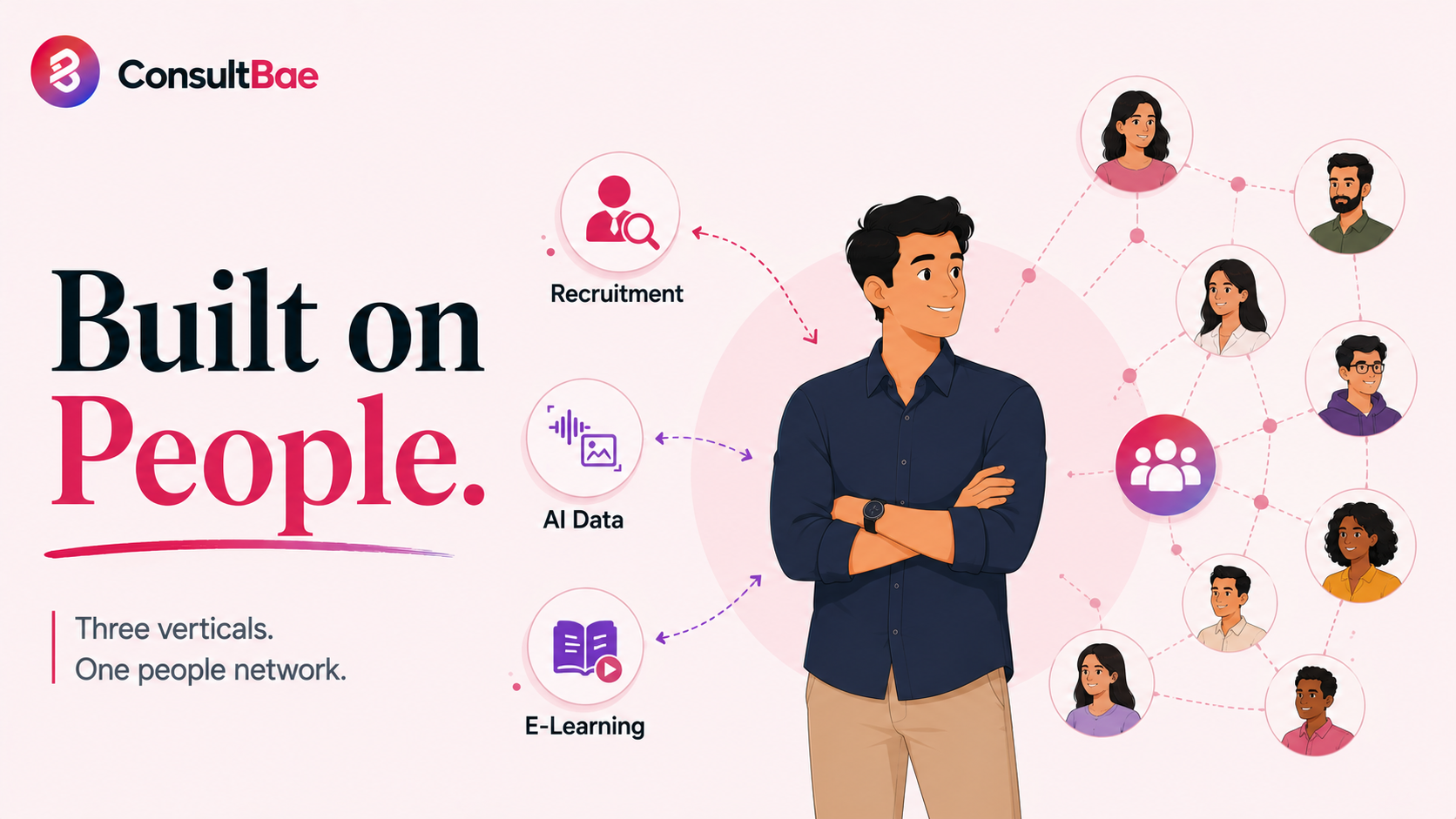
The recruitment vertical places mid-senior professionals into permanent or contractual roles for companies that need to build or expand their teams. The AI data vertical sources contributors across 100 plus countries to collect, annotate, and validate data for organisations training machine learning models. The e-learning vertical finds subject matter experts, instructional designers, actors, and voiceover artists for platforms building certification courses. On the surface, these look like three different businesses serving three different markets.
They are not. They share the same operational core: a database of people, a sourcing process that can find the right person for a specific brief, a screening and qualification framework, an onboarding process, a delivery management layer, and a quality review mechanism. Each vertical applies this core to a different type of person for a different type of client need. The core does not change. The application does.
This is also why each vertical has been able to grow by drawing on the capabilities built by the others. The recruitment database was the foundation that made it possible to quickly source the first wave of AI data contributors in India. The AI data contributor network, built out across 100 countries, is now the foundation that makes it possible to source subject matter experts for e-learning clients in geographies a pure e-learning operation would never have access to. Each vertical makes the others stronger because they all run on the same underlying people infrastructure.
"We are purely someone you can say as a human resource company where people bring their expertise to build things up. We connect people to people who need them. That is the whole business, across every vertical."
The Technology Layer Versus the Human Layer
ConsultBae uses technology extensively. The applicant tracking system and candidate relationship management platform carry artificial intelligence features that help prioritise which candidates to contact first. The database of over two million candidates was built over six years and is maintained through ongoing sourcing and engagement activity. The project management tools used for AI data collection automate task assignment, track contributor completion rates, and flag quality issues for human review. None of this is cosmetic.
But the technology is infrastructure, not product. The product is the human capability that arrives at the client's side. An engineer who joins a delivery team. A linguist who records a dataset. A subject matter expert who validates a course. These are people. The technology facilitated the sourcing and management process that brought them to the client. It did not produce them.
This distinction matters practically because it determines where the investment goes and where the risk sits. A technology-first approach to this business would invest primarily in the platform and assume the people problem is downstream. A people-first approach invests in the network: the relationships, the sourcing channels, the qualification processes, and the trust that makes contributors, candidates, and clients want to stay in the ecosystem. The network is the asset. The technology serves the network.
What Clients Are Actually Buying When They Work With Us
Clients who work with ConsultBae are not buying access to a platform or a database. They are buying the outcome of a network that took years to build and a process that took hundreds of projects to refine. When a US-based technology company receives a shortlist of pre-qualified engineers within two weeks, what they are buying is not the applicant tracking system that generated the shortlist. They are buying the two million candidates that were available to search, the qualification process that filtered them to the right profiles, the account management that translated the client's needs into a search brief, and the relationship infrastructure that makes candidates responsive when we reach out.
When an AI model builder receives a clean, annotated audio dataset collected from 350 contributors across 20 countries, what they are buying is not the annotation tool that structured the collection. They are buying the contributor network in those 20 countries that was built from scratch, the onboarding process that got 350 different people to record to a consistent standard, the quality review that caught and replaced the recordings that did not meet the brief, and the project management that delivered the dataset on the committed timeline.
In both cases, the purchase is the accumulated human infrastructure. That infrastructure took time to build and cannot be replicated quickly by a competitor with a better platform. It is the durable part of what we offer, and it is what makes the technology useful rather than the other way around.
Why This Framing Holds Even as the Industry Changes
The argument against calling yourself a people company in 2026 is that automation is reducing the need for human labour across a growing number of task categories. If AI can annotate data, generate course content, and screen candidates, why is a people company positioned for the future?
The answer is that automation is changing which tasks require human execution, not whether human capability is needed. The tasks that are being automated are largely the generic, high-volume, low-judgment ones. The tasks that are growing in value are the specialised, context-dependent, judgment-intensive ones: the medical professional whose domain expertise validates a clinical AI model's training data, the senior engineer whose specific combination of skills a growing US company cannot hire locally, the marketing director whose hands-on experience with a specific analytics tool gives a certification course the practical credibility that AI-generated content cannot provide on its own.
Recruitment: Find a professional with a specific skills profile, verify their experience and fit, place them in a role where their capability matches the client's need, manage the relationship through placement and beyond.
AI Data: Find contributors with a specific demographic or domain profile, verify their capability and availability, onboard them to a collection or annotation brief, manage their output through a project until the dataset meets the client's quality standard.
E-Learning: Find a subject matter expert, actor, or voiceover artist with specific expertise and communication capability, verify their fit for the course brief, onboard them to the production process, manage their delivery through the project until the course component meets the platform's standard.
The task changes. The core process does not. That consistency is what makes the people company framing accurate rather than aspirational.
The companies best positioned to connect the right people to those high-value, specialised needs are not the ones with the best automated screening tools. They are the ones with the deepest networks, the most refined qualification processes, and the longest track records of delivering human capability at the level of specificity the market increasingly demands. That is what a people company is. It is what we are building.
Need the Right People for a Specific Need?
ConsultBae operates across recruitment, AI data, and e-learning with a single shared capability: finding the right human for your specific task and managing their delivery end to end. If your need involves people, we have likely solved it before.
Explore a Partnership