- The most common misunderstanding about staff augmentation
- What on our payroll, working for your project actually means operationally
- The adjusted-hours model for cross-border collaboration
- When staff augmentation is the right choice and when permanent hiring is
- What the commercial and management responsibilities look like in each model
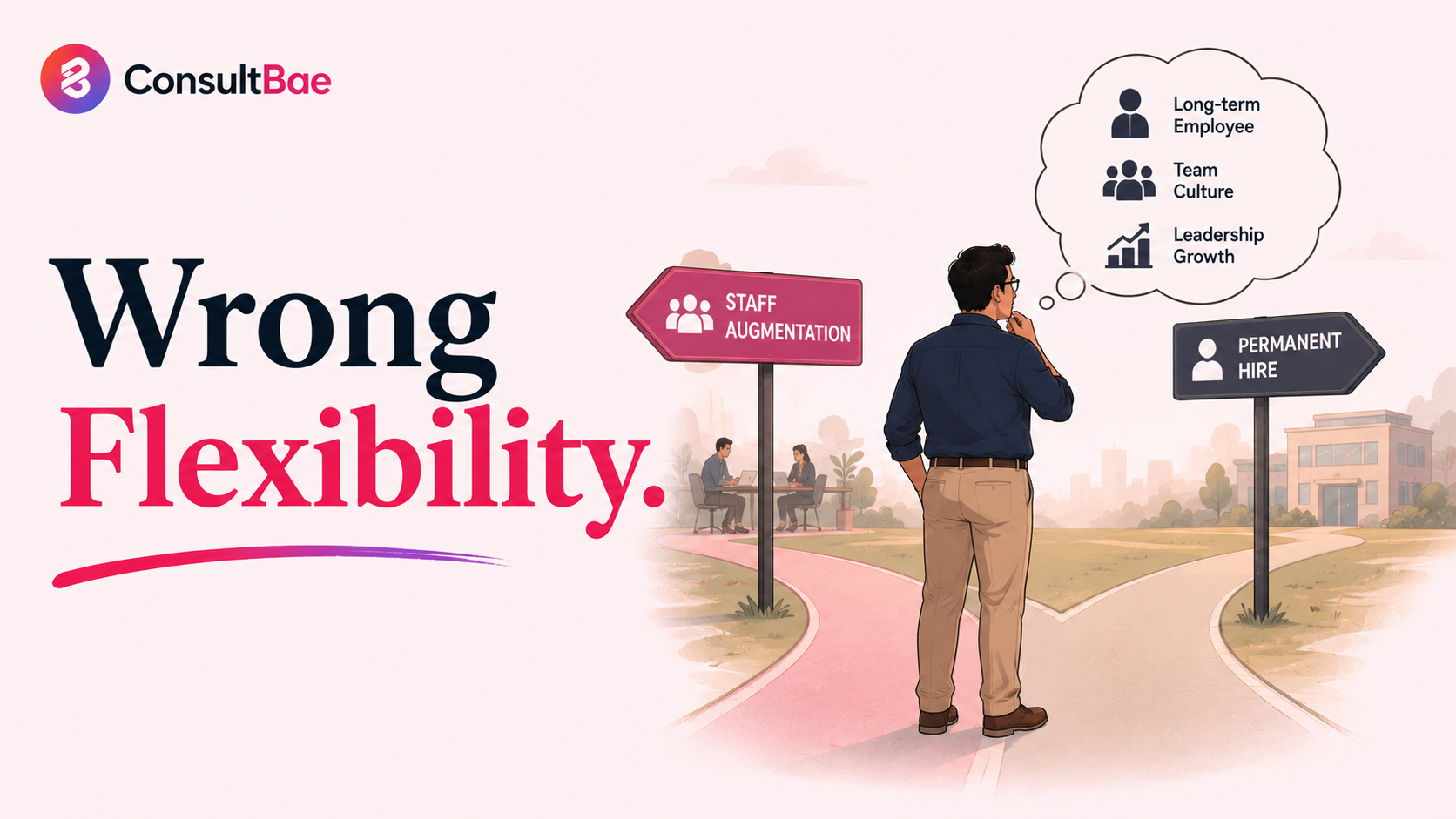
The phrase staff augmentation tends to get used loosely, as if it describes a single product with predictable characteristics. In practice, it describes a broad category of arrangements that differ significantly in how they are commercially structured, who carries management responsibility, and what the client actually receives for the engagement fee. Getting this wrong at the point of decision, choosing staff augmentation when the need calls for permanent placement or expecting permanent placement quality from an augmentation structure, produces friction that builds throughout the engagement and is expensive to unwind.
The confusion is understandable. Both models involve a person doing work for a company. In both cases, that person has a specific skill set, reports into someone on the client side, and produces output that the client uses. The difference is in everything that surrounds the work itself: who employs the person, who is responsible for their performance management, what happens when the scope changes, how the engagement ends, and what the cost structure looks like across the full duration of the project. These are not administrative details. They are the operational architecture of the engagement, and they need to match the actual nature of the need.
The Most Common Misunderstanding About Staff Augmentation
The most common misunderstanding is that staff augmentation is a cheaper or faster version of permanent hiring: the same output, lower commitment, lower cost. This is wrong in a way that produces predictable disappointment. Staff augmentation is not a discounted permanent hire. It is a different product designed for a different set of needs, and its value is only realised when it is used for the need it is built for.
Permanent hiring is the right model when a company needs someone who will be deeply integrated into its culture, who will grow with the organisation over time, who will carry institutional knowledge that accumulates across years of employment, and whose career trajectory within the company is a relevant consideration for retention. The investment in onboarding, in relationship-building, and in the management infrastructure that supports a permanent employee is justified because the person is expected to be present for long enough that the investment returns.
Staff augmentation is the right model when a company needs specific technical capability for a defined period, when the scope of the work is clear enough to be managed as a project rather than as an evolving role, when the company needs to scale delivery capacity up or down in response to workload changes without the HR overhead of hiring and potentially separating permanent employees, and when the management structure on the client side can direct the work without the augmented resource needing to be embedded in the cultural and career management infrastructure of the permanent team.
These are genuinely different situations. The commercial structure, the onboarding investment, the performance management approach, and the expectations on both sides are all calibrated differently for each. Applying one model's assumptions to the other produces the mismatch that results in client frustration and underutilised resources.
What On Our Payroll, Working for Your Project Actually Means Operationally
In the ConsultBae staff augmentation model, the resource is employed by ConsultBae, not by the client. This means ConsultBae handles the employment compliance, the payroll processing, the statutory benefits, and the baseline HR management of the individual. The client does not take on an employment relationship. They take on a service relationship, in which they are directing the work output of a resource whose employment infrastructure is managed by the staffing partner.
This structure has specific operational implications. Performance issues that go beyond the scope of work direction, concerns about conduct, persistent capability gaps, the decision to end the engagement: these are managed through the staffing partner rather than through the client's HR function. The client can direct the work, provide feedback, and request a replacement if the resource is not performing to the standard required. But they are not managing an employee. They are managing an output, and the infrastructure of managing the person producing that output sits on the partner's side.
For clients who are used to managing permanent employees, this distinction sometimes requires adjustment. The impulse to manage a staff augmentation resource the same way they would manage a direct report can produce friction because the resource's formal accountability runs through the partner, not through the client's management structure. Understanding this before the engagement begins prevents the confusion that arises when the client tries to exercise management authority that the model does not structurally support.
"Staff augmentation is not a cheaper way to hire someone permanently. It is a different way to access capability for a defined project scope, with the employment infrastructure managed by the partner rather than the client. The flexibility it provides is real, but it is a different kind of flexibility than permanent hiring offers."
The Adjusted-Hours Model for Cross-Border Collaboration
A specific and increasingly common application of staff augmentation in the India-US context is the adjusted-hours arrangement, where resources based in India work a shifted schedule designed to maximise real-time overlap with the US-based team they are supporting. Standard India business hours produce almost no overlap with US East Coast or West Coast working time. An adjusted schedule, starting later in the Indian evening and running into what is early morning US time, can produce four to six hours of synchronous working window that makes genuine collaboration possible rather than relying entirely on asynchronous handoffs.
This arrangement is only viable in a staff augmentation model, not in a permanent employment model. A permanent employee in India who is expected to work US business hours would be working nights indefinitely, which creates welfare, retention, and legal considerations that make it operationally problematic at scale. A staff augmentation resource working on a project with a defined duration and a clear scope can work adjusted hours for the project period under an arrangement that is transparent, compensated appropriately, and bounded by the project timeline rather than by an indefinite employment commitment.
The value to the US client is significant. A delivery team in India working adjusted hours and available for real-time collaboration during the US working day functions much more like an in-house team than a traditional offshore resource. Questions get answered in the same meeting. Problems get solved in real time. The collaboration quality improves in ways that asynchronous-only arrangements cannot replicate, and the cost advantage of India-based talent is preserved while the collaboration disadvantage of the time zone gap is substantially reduced.
When Staff Augmentation Is the Right Choice and When Permanent Hiring Is
Staff augmentation is the right choice when the need has a defined project scope, when the duration is bounded even if the exact end date is uncertain, when scaling the team up or down in response to workload changes is a likely requirement, and when the client has a clear enough brief to direct the work without needing the resource to develop in the role over time. It is also the right choice when the client wants to evaluate a resource before making a permanent commitment: a well-structured augmentation engagement is an extended working interview that produces much better evidence of fit than any structured interview process can.
Permanent hiring is the right choice when the role requires deep cultural integration, when the person needs to develop significant institutional knowledge to perform effectively, when the career trajectory within the company is a relevant retention consideration, and when the nature of the work is expected to evolve substantially over time in ways that a defined project scope cannot accommodate. It is also the right choice when the client needs someone who carries the company's identity and values into client-facing or leadership contexts where the employment relationship is a signal of commitment.
The question to ask before deciding is not "which model is cheaper?" but "what does this role actually require from the person filling it, and which structure supports those requirements better?" The answer to that question determines the model. The model should follow the need, not the other way around.
What the Commercial and Management Responsibilities Look Like in Each Model
In permanent placement, the staffing partner's responsibility ends when the candidate joins the client. The commercial relationship is a placement fee paid once, and the ongoing employment, management, performance review, compensation adjustment, and eventual separation are all the client's responsibility. The partner's continuing involvement is limited to any replacement guarantee period specified in the agreement.
In staff augmentation, the staffing partner's responsibility is continuous throughout the engagement. The partner is managing an employment relationship in parallel with the client's project relationship. Payroll, statutory compliance, HR administration, performance management outside the scope of work direction, and the logistics of ending or replacing the engagement: all of these run through the partner. The commercial structure reflects this: rather than a one-time placement fee, the client pays a monthly or project-period rate that covers both the resource's compensation and the partner's ongoing management overhead.
Staff augmentation provides: Access to specific technical capability for a defined project scope, with employment infrastructure managed by the partner. Commercial structure is a rate per period. Management responsibility is split between client (work direction) and partner (employment management). Flexibility to scale up or down is structurally built in. Best for defined project needs, cross-border collaboration, and capability evaluation before permanent commitment.
Permanent placement provides: A candidate who joins the client's employment, integrates into the client's culture, and develops within the client's career structure. Commercial structure is a one-time placement fee. Management responsibility shifts entirely to the client after joining. Best for roles requiring deep integration, long-term development, and cultural identity.
The key question before deciding: Does this role require the person to be part of the company in a durable cultural and institutional sense, or does it require specific capability applied to a defined scope for a defined period? The answer to that question, not the cost comparison, should determine the model.
The flexibility that staff augmentation provides is real and valuable when it matches the flexibility the client actually needs. When it does not match, both sides discover the mismatch in the operational friction that accumulates as the engagement tries to function as something it was not designed to be. The conversation about which model fits which need is worth having before the first profile is sourced, not after the engagement is already running in the wrong direction.
Not Sure Which Staffing Model Your Need Requires?
ConsultBae runs both permanent mid-senior placement and staff augmentation, including adjusted-hours delivery teams for US-based clients. We start by understanding the need before recommending the model.
Talk to Our Hiring Team