The first project with a new data client is almost never the most important one. It is the test. Both sides are learning how the other operates, where the friction points are, what good communication looks like, and whether the relationship is worth investing in beyond the immediate scope. The projects that matter are the ones that come after.
Most data vendor relationships do not survive that first project. The work gets delivered, the engagement closes, and when the client has their next data need, they go back to the market and start the evaluation process again. This is not always a sign that the first project went poorly. Often it went fine. It just did not build enough connective tissue between the two organisations to make the next engagement an obvious continuation rather than a new procurement decision.
The relationships that do survive past the first project tend to follow a recognisable arc, and the value they create for both sides grows in ways that single-project engagements cannot replicate.
The pilot phase
The first engagement is structurally a pilot, even when it is not formally labelled as one. The scope is contained, the volume is modest, and the primary purpose, from both sides, is to find out whether the working relationship is functional.
What the client is testing in this phase is not just the vendor's ability to deliver data. They are testing whether the vendor responds quickly to questions, whether their communication is clear when things are ambiguous, whether their quality holds up to scrutiny, and whether they handle the inevitable small problems gracefully. The data itself matters, but so does everything around it.
What the vendor is testing is the client's expectations: whether the brief was specific enough to act on, whether the client is responsive when the vendor needs input, whether scope can be adjusted when the work surfaces issues the brief did not anticipate, and whether the relationship has the give and take that complex projects require.
The scale transition
The first project after the pilot is where most relationships either deepen or quietly end. If the pilot went well, the client has a real piece of work they want done at higher volume. The vendor's operational infrastructure either extends to that volume or it does not. This is where partnerships that look strong on paper often run into trouble, because the small-scale collaboration that worked in the pilot does not automatically scale.
The vendors that get through this transition cleanly tend to do two things. They invest in the scale-up phase rather than treating it as a continuation of the pilot, which means building the operational layer the production project requires before the volume arrives. And they are transparent with the client about what changes between pilot and production, including the trade-offs they are choosing to make and the ones the client will need to decide on.
The relationships that mature are the ones where both sides invest in the second project as if they want a tenth. The relationships that end at project one or two are usually the ones where neither side felt that.
The expansion phase
Past the production transition, partnerships that hold start to expand. The client has new data needs, and instead of starting fresh evaluations, they ask the vendor whether the existing relationship can be extended. The vendor knows the client's standards, communication patterns, and operational rhythm by now. The client knows what the vendor can and cannot do.
Expansion looks different depending on the client. For some it means adjacent modalities — a client who started with speech collection adds image annotation. For others it means new geographies — a client who collected in five countries asks for ten more. For others it means new use cases — a client building one model adds a second team building a different model, and the relationship covers both.
The shift in this phase is that the vendor moves from being a contracted supplier to being an extension of the client's data operations. They sit closer to the strategy. They are included in conversations earlier. They begin to operate with context the client did not have to explain because the trust to give it was built over multiple cycles of delivery.
The mature partnership
By year three or so, the partnerships that have made it this far look qualitatively different from the early engagements. The vendor proactively flags issues the client has not yet noticed. They suggest scoping changes based on patterns they have seen across the work. They contribute to data strategy conversations rather than waiting to be briefed on a project that is already scoped.
The client, for their side, treats the vendor as part of how they think about data. New requirements get discussed with the vendor early, before they are formalised. Trade-offs between speed, cost, and quality get negotiated in the open rather than imposed through a brief. The vendor is invested in the client's broader goals, not just the immediate project.
This is what a mature data partnership looks like. It is also significantly more valuable to both sides than any single project could be. The vendor has predictable, ongoing work and deep context that lets them deliver more efficiently. The client has a reliable data partner who is improving over time, not a new vendor relationship to bootstrap every time a new need arises.
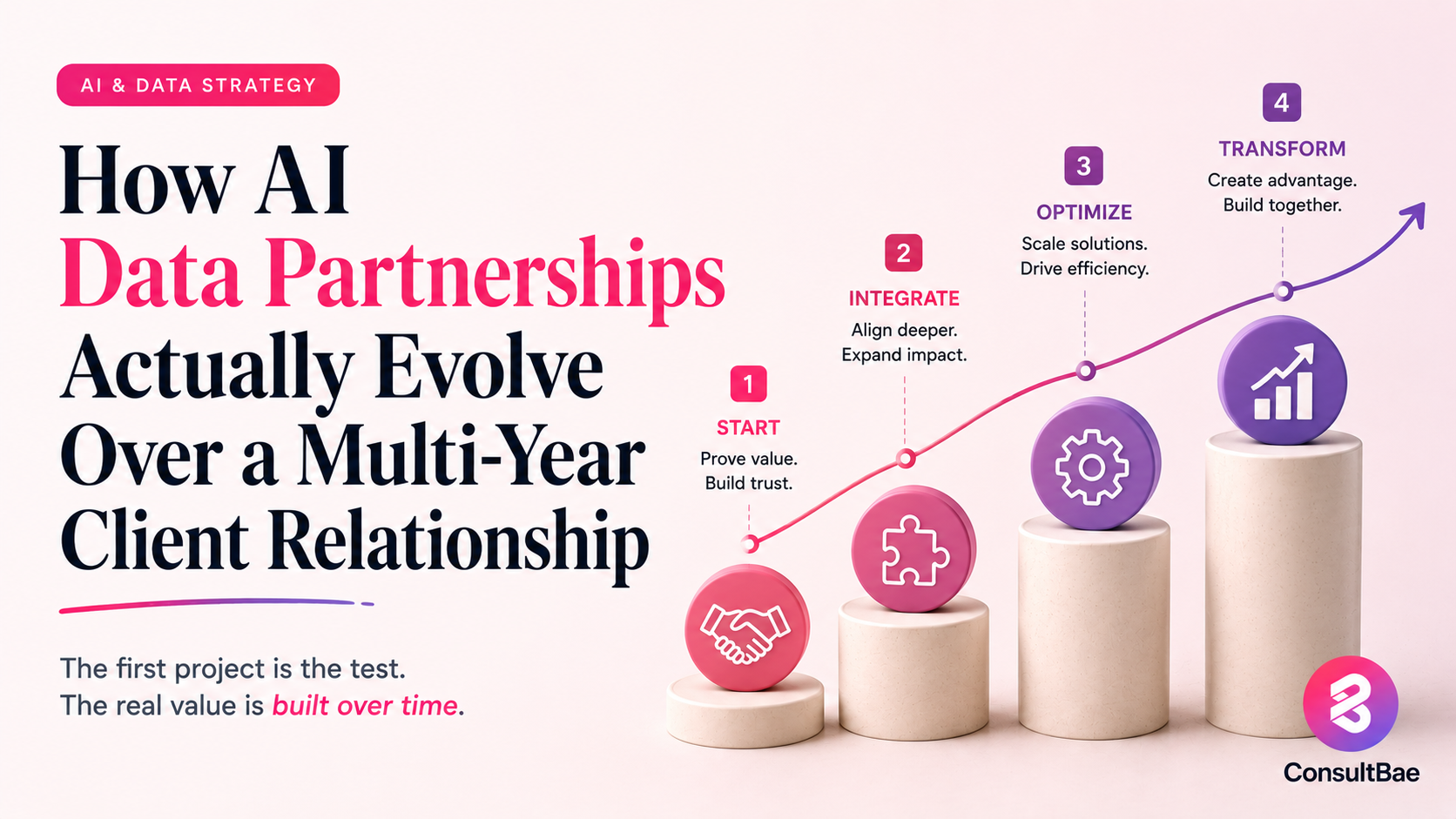
Pilot: Working trust. Each side has tested the other on a contained engagement and decided it is worth continuing.
Scale transition: Operational confidence. The vendor has shown it can handle production volumes. The client has shown they can support the work at that scale.
Expansion: Strategic context. The vendor knows the client's broader data picture. The client knows the vendor's full range of capabilities and how to deploy them.
Mature partnership: Embedded operations. The vendor functions as an extension of the client's data team. The work is predictable, proactive, and increasingly efficient.
How ConsultBae thinks about this
At ConsultBae, the relationships that matter most to our business are the ones in the mature phase. They represent years of investment from both sides and produce work that benefits from depth of context neither party could replicate quickly with someone new.
We work hard on the early phases for that reason. The first project is not just a transaction. It is a foundation. The pilots that go well, the scale transitions that we plan carefully, the expansions we earn through consistent delivery — all of it is building toward partnerships that produce real value over years, not single engagements that close out and need to be rebuilt.
The best AI data work happens inside relationships that have had time to develop. That is true for us, and it is true for the clients we work with longest.
Mohit Singh Katewa leads the AI Data vertical at ConsultBae, overseeing data collection, annotation, and quality operations across 100+ countries.
Looking for a data partner, not just a vendor?
ConsultBae works in long-term partnerships with clients building AI. Let us talk about what you are working on.
Talk to us